
The film Arrival begins with a classic sci-fi thought experiment, what would happen if massive alien objects arrived all over the world. The film ends with those objects not launching back into space, but slowly elevating and disappearing into the clouds. In between, a thrilling story of humanity’s first “alien encounter” unfolds. Interestingly, we never see the flying saucers in space at all, just hovering over the earth and then assumed into the sky. It is as if this encounter may not have been with aliens from outer space, but with messengers from above. The most distinctive image of the film—featured on the movie poster itself—is a vertically oriented object looming over the countryside. It appears like a large oblong stone, its massive length oriented toward the sky, a naturalistic skyscraper–or cathedral spire. The action of the film follows that image, elevating the mind to God without mentioning God once.
Consider another iconic alien invasion story, Independence Day. A colossal saucer hovers over New York casting an ominous and oppressive shadow over the city. While every gaze under the Independence Day saucer would be drawn skyward–the only likely reactions would be fear and dread.
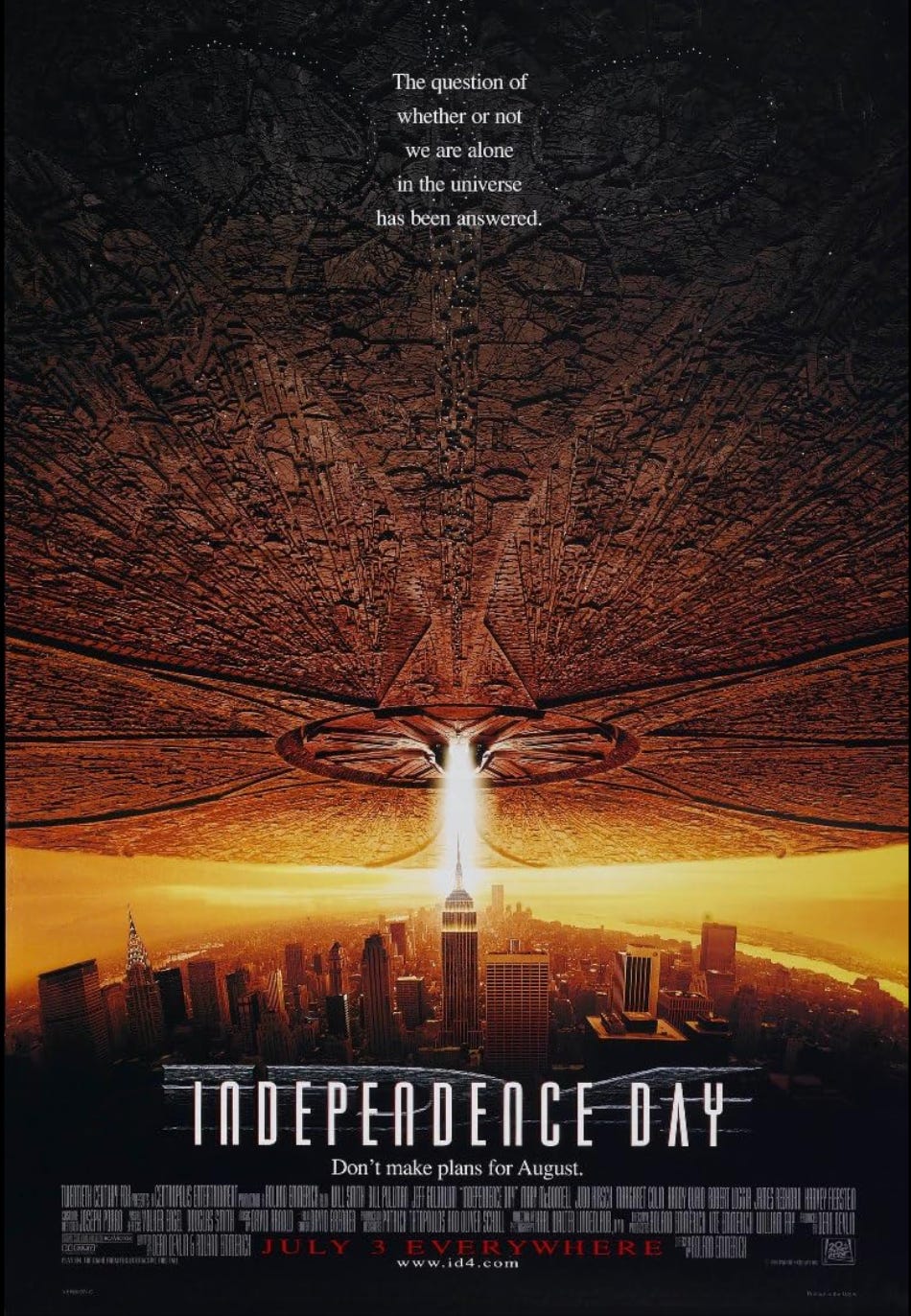
Compare that with Arrival. The Arrival object is beautiful, resting on a bed of clouds, reaching toward the heavens. The poster reveals a glimmer of the sun shining forth from behind its bulk, suggesting hope. Forrest Whittaker’s camouflage gear and stern expression along with the circling military helicopters let us know that this is not some cuddly alien encounter, however. It is an awesome sight. The director likely considered the movie poster itself something of a spoiler as the reveal of the objects in the film is done in measured moments, obscure and distant at first before being revealed in full.

A Summary: Louise Banks (Amy Adams) is a language expert recruited along with physicist Ian Donnelly (Jeremy Renner) by Colonel Weber (Forrest Whittaker) to assist the government in communicating with the otherworldly visitors. Time is of the essence as leaders around the world are deciding how to deal with this “arrival” and some believe the best defense is a good offense. Banks assistance includes entering the object and attempting to speak with the visitors. With the clock ticking, they must figure out this new language and establish communication before a global and potentially intergalactic military conflict begins.
The title of the story on which the film is based is “The Story of Your Life.” Elements of Banks’ life are presented in brief vignettes including the loss of a child to when the child is in her teens. Director Dennis Villeneuve shares Banks’ suffering with the audience early in the film as the story of the encounter unfolds, letting us know that this cosmic confrontation has profound resonance on the micro scale. The implications of the intergalactic encounter are brought so close to home that the family story seems to carry as much gravity as the global international incident. The breakthrough in the presentation of time in the film allows us to reflect on Banks’ embrace of her marriage, pregnancy, and the arrival of her child who she knows will suffer and die. At the same time, we get the excitement and drama of the thought experiment of “how would the world react?” to an encounter like this. International cooperation–and lack thereof–disorder in the streets–looting–shortages, etc. all unfold behind the main action of the film. We never forget the stakes.
Charles M. Schultz (creator of Peanuts Charlie Brown) writes in the introduction to a collection of Calvin and Hobbes, that Watterson has made a comic that is fun to look at. Beautiful panels and clever drawings make Calvin and Hobbes a delight, aside from its other merits of being smart and hysterically funny. while there is little comedy in Arrival, the depiction of the objects, inside and out, is arresting, and so are the creatures themselves. The challenge of depicting life from another world has lurked over science fiction from the beginning of the genre. Arrival is not the first to opt for a cephalopod style (they are called “heptapods” here for their seven octopus-like appendages [each with seven octopus like “fingers”]), but in this version they are presented as huge, almost hand-like creatures. While referencing many classic sci-fi representations of aliens (including Kang and Konos from The Simpsons), these creatures present a unique heft and mystery in their appearance. We never see one in its entirety or in full clarity. The closest we get to a full view is a shot from behind as one looks down on Louise, and it towers over her. They maintain an awesome mystery about them even when they are on screen. Their hand-like appearance is like the hand of God reaching down to interact with humanity. They float amidst clouds, literally shrouded in mist. When inside their space, the rules of nature do not apply–gravity itself is altered. They bestow a supernatural gift on Louise. And when confronted with violence, they do not retaliate, but simply leave, their craft assumed into the clouds. We do learn that one of the creatures is injured and “in the death process,” (not dead or dying however), so they are not presented as immortal beings, but they seem to represent something more than green men from mars.
Part of the appeal of Arrival is its puzzle-like quality. After my one viewing, many questions remain. Why were their twelve (not ten or fifteen) objects scattered over the globe? A reference to the 12 apostles? The 12 tribes of Israel? The objects look like stones, are they meant to represent the scattering of the languages after the Tower of Babel? I had a physics teacher in high school who liked to say, “we have a hard time with… Time.” And of course he’s right. What would it mean to understand life outside of time? How are we to understand our free decisions in life after knowing how it will end? This movie takes a crack at that. Banks’ embrace of the life of a child she knows will suffer and die is presented as a joyful one, despite the consequences. Is the creative use of time in the film intended to suggest a view of life from eternity? A God’s eye view? We are invited to contemplate a singular, mysterious, otherworldly arrival of aliens (that act a bit like angels?). At the same time, we can question what other arrivals are suggested by the title and the film. The arrival of the child? the arrival of understanding? or the arrival of a person into eternity? We also end up considering recurring, ordinary, real-world events and their implications in our time. I don’t know if the director set out to make a film that invites the viewer toward an act of prayer, but I think he has done just that.
Have you seen the new Obama Presidential Library? Very on point.