
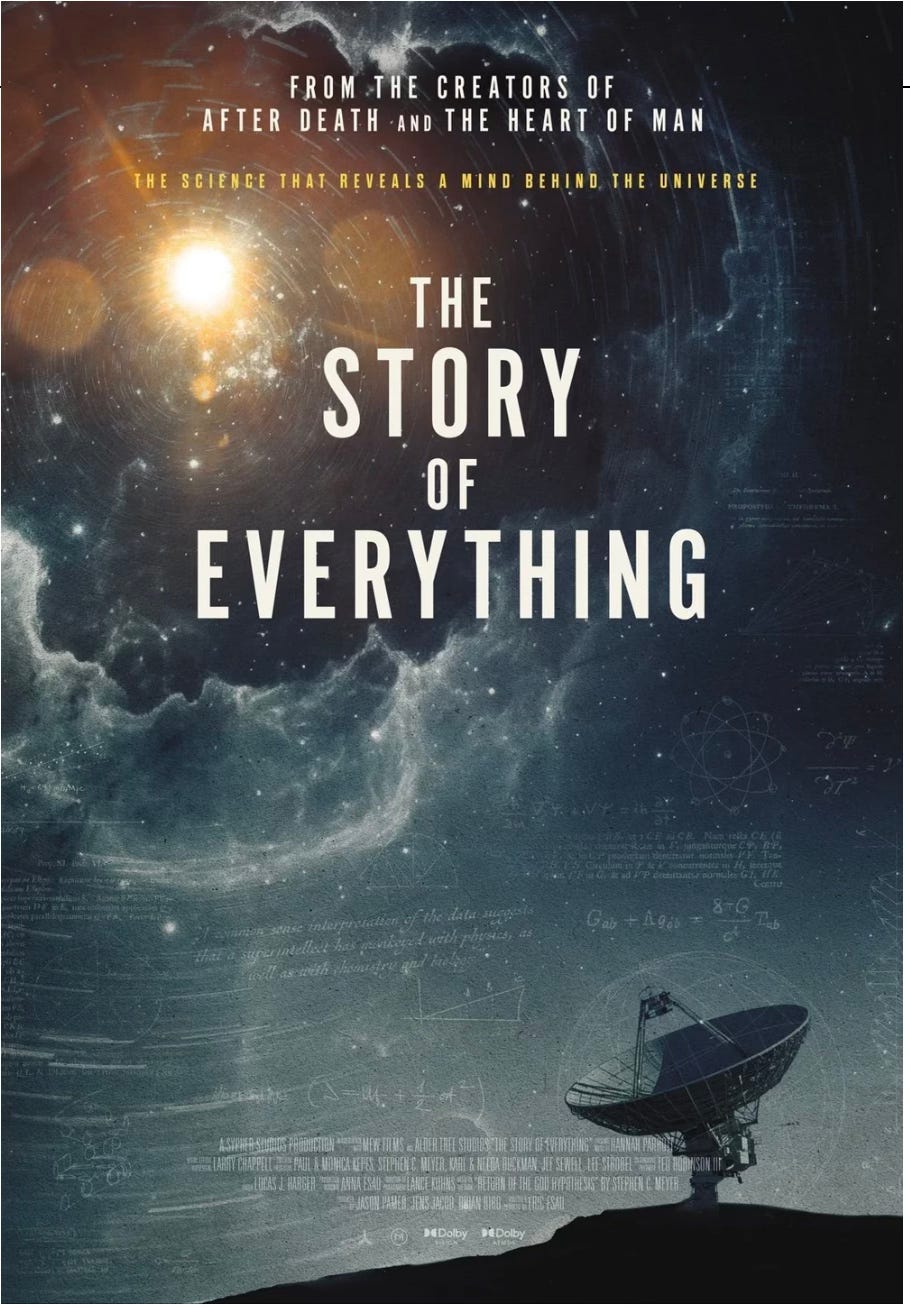
The Story of Everything makes what would have been an ambitious two hour lecture on the scientific evidence for the intelligent design of the universe into an ambitious, engaging, and entertaining film. It tackles an amazing array of topics in two hours, from changing theories on the origins of the universe, the incomprehensibly fine-tuned character of our universe to exist at all and—even more remarkably—to support life, to the origin of life including the complexity of “simple” cells and the amazingly intricate “machines” that make them work. All this is explained clearly enough for a lay audience and with enough visual and narrative interest to hold an audience’s attention. The visuals are quite good, if eventually redundant. The Cell mechanic depictions were particularly good. It is a high quality production of Stephen Meyer’s arguments that science points to a creator, and it is convincing.
The history of science sections include a few vignettes that highlight the lengths to which some of the most renowned scientists have gone to avoid the conclusions that most obviously result from their work, that there is a mind behind creation. Einstein’s use of a manufactured “cosmic constant” that he would later declare his biggest blunder (after being shown his error by a Catholic priest). Stephen Hawking’s “workaround” to avoid the most obvious conclusion to draw from his own work, that the universe had a beginning. As Meyer shows the mind-boggling complexity of even the simplest cells, he reminds us of Darwin’s statement that his theory would fall apart if evolution requires large complex changes, and not small simple ones.
More than challenging many popular views about the origin of the universe and of life, the film does a great job of rejecting the idea that science and religion are opposing concepts or pursuits. Meyer poignantly quotes Romans 1:20:
For the invisible things of him, from the creation of the world, are clearly seen, being understood by the things that are made . . .
Looking at the world and finding God is part of God’s plan for how we may know Him. This includes looking at the world through high powered telescopes and with electron microscopes. We shouldn’t be surprised if our study of the world provides compelling evidence that He exists and created that world for us.
There were many new insights in this film, but my favorite may have been in the section about the miraculous “fine tuning” of the universe to exist and support life. The fine tuning concept is that if any small conditions were changed—even a tiny amount, things just wouldn’t work. If gravity were operated differently by a tiny fraction, life could not exist. The existence of the large gas planets in our solar system—Jupiter, Saturn, Uranus, and Neptune—are a part of that fine tuning as well. They provide a shield for the earth, catching comets that could otherwise demolish the Earth. Without those planets, who knows how many times the earth would have been pummeled with space debris large enough to end the possibility of life. It’s like the earth is the quarterback and these giant planets are the offensive line.

There is a lot in this film, much more than I could absorb in one sitting. Using a series of different experts, examples, and visual depictions, this two hour lecture is an enjoyable watch. The film is distributed through Fathom Events and has been extended for an additional week. It is worth the trip.
Content Warning: None. Younger kids would probably struggle with the level of intellectual discussions.
Wish my nuclear physicist father were less harmed by a dementia-like nueurological disorder, so he could have seen it. Maybe when it comes out on video, he could manage 30 minutes of it. In the old days, we would have seen it, and then he would have spent an hour half-enlightening me and half-overwhelming me with various physics theories about the universe and everything in it.
OT, but I have a new post up that collects the links to all my Odyssey writings of the last few years, to get us ready for Nolan's film. https://dissidentcon.substack.com/p/my-writings-on-the-odyssey