
“Wait? Did anyone consult the rock musicians?”
This question is rarely asked in the War Room.
That hasn’t stopped them from weighing in through the years. Their guidance is usually straightforward, “War is bad, please avoid.”
Why do they keep saying this? After all, who thinks war is good? Is an anti-war song just a predictable refrain, not saying anything particularly relevant?
General Robert E. Lee, while watching his Confederate lines repeatedly repel Union advances (resulting in some 12,000 casualties on the Union side to 5,000 on Lee’s) at the battle of Fredericksburg, turned to General James Longstreet and said: “It is well that war is so terrible, or we should grow too fond of it.” He had seen it all, and yet he was aware of the grim attraction of the whole enterprise, smoke, fire, sound, fury, life, and death.
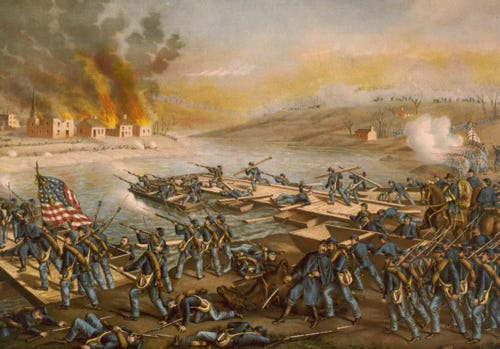
There is a risk of forgetting the stakes of a military operation. The fact is that the results—at the micro-personal level—are always bad. And not only bad for those who are injured, killed, lost, and left behind during the events. Even when you are safe and victorious, as Lee was at Fredericksburg, there is a mortal risk—at the soul-u-lar level—of taking delight in the process.
These songs are not about the present operation and they are not protest songs, exactly, but they offer a reminder, in their own way, of what is at stake. They are also terrific songs that find their way back into my listening rotation regularly.
Life During Wartime
Talking Heads on the 1984 Album Stop Making Sense (Live) and 1979 album Fear of Music
This energetic and deceptively upbeat song documents the trials of life under siege and on the run during a war. The lyrics read like moments from a spy thriller. “I got three passports, couple visas, don’t even know my real name.” It paints a desperate portrait of life after the bombs while fighting for survival. There is excitement and even hopefulness in this adventure (“we make a pretty good team”), but what is lost grows more profound, as we go from “no party,” “no disco,” “no speakers, no headphones, no records to play,” to “can’t write a letter” and “can’t write nothin’ at all.” David Byrne’s vocals grow in their manic anxiety until all that is left is the drive for survival:
Burned all my notebooks
What good are notebooks?
They won’t help me survive
My chest is aching
Burns like a furnace
This burning keeps me alive
16 Military Wives
The Decemberists on the 2005 album Picaresque
“16 Military Wives” is a zany, searing, critique of the role of propaganda in wartime and begins with the cost up front—military widows and the children left behind. Likely written to target the Bush administration specifically, they have written a song that pushes the problem of war mongering to an absurdist breaking point, and created something more timeless than an topical opinion-piece as a result. By zeroing in on the military wives, the ones who will be left behind, the song grabs a hard moral center. Through and a series of increasingly bizarre number plays, (16 military wives, 32 softly focused eyes, 32 gently clutching wrinkled little hands, 15 celebrity minds, 14 cannibal kings [an homage to Swift’s “A Modest Proposal”?]), the song sets its sights on the media (and others) who choose to see no evil like “The anchor person on TV who goes ‘Laa dee-da dee-da dee-da-dee-da-de-daaaaAh!’” A great horn section and improbable drum fills complete the arrangement of an all time great track.
Us and Them
Pink Floyd on the 1973 Album Dark Side of the Moon
We talked about Dark Side of the Moon and Pink Floyd and Parenting earlier. In the song “Us and Them,” Roger Waters, Pink Floyd’s chief lyricist and creative powerhouse, has written a reflection on war from many perspectives through a series of simple word pairings, “Us and Them, Me and You, Black and Blue, Up and Down, etc.” No Dr. Seuss rhyme here, however, Waters has his sights set on bigger game, “Down and Out, it can’t be helped, but there’s a lot of it about. And who’ll deny its what the fighting’s all about.” OK, maybe not that profound, but it’s a great song with a terrific organ intro, soaring backing vocals, and a terrific saxophone solo.
Goodnight Saigon
Billy Joel on the 1982 album The Nylon Curtain
After an erie introduction featuring the sound of an approaching Huey helicopter, Billy Joel unfurls a tale from the Vietnam war, from training, to deployment, to seeing friends fall in the fight. Through a series of brief vignettes, “Goodnight Saigon” manages to bring home the struggle and remember the cost. No anti-war screed here, Joel’s song is a tribute to the men who fought (Joel did not) and a lament for those who did not come home, culminating in the stirring chorus that brings home the pull of camaraderie, “We said we’d all go down together.”
Fort Hood
Mike Doughty on the 2008 Album Golden Delicious
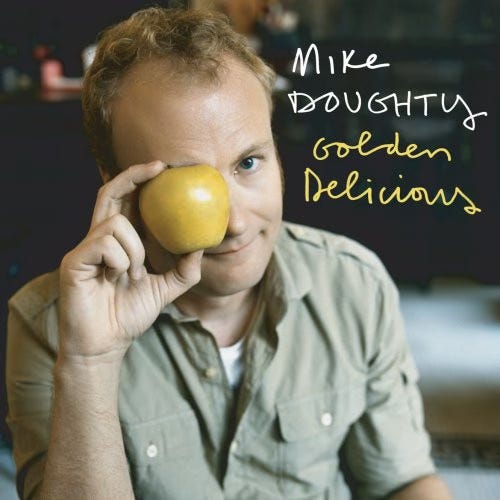
Mike Doughty’s irresistibly funky reflection on wartime is named for the Army base in Texas, although “Fort Hood” does not appear in the lyrics of the song itself. Doughty’s song is an uncomprehending look at those who have chosen to fight—the soldiers themselves. He just doesn’t get it: “I’d rather clank on the bass in a cold basement. I’d rather keep the fire and the frenzy out of my mind.” But he fears for the veterans he sees traumatized upon return, “I see them coming back, motionless in an airport lounge.” He wants these young men to be out with “a prom dress girl” and to “still believe in an endless world” and ultimately appeals—in his hard-to-believe-this-is-a-professional-singer tone—in desperation (and in reference to a Vietnam Era 5th Dimension song) to “Let the sunshine in.”
Are there any pro-war rock songs out there? None come to mind. Vince Vance and the Valiants famously parodied the Beach Boy’s “Barbara Ann” with “Bomb Iran” amid the 1980 Iran hostage crisis, but that was just that, a parody. This seems right, too. There would be something grim about popular music celebrating the reality of war. Rockers are not statesmen, and they are not sources of wisdom when it comes to foreign policy or military strategy, but they may have something to offer. I share these songs not as a position on the current conflict, but as a reminder—one that even Robert E. Lee might have found worthwhile.
Here’s the link to the playlist.
None coming to mind...
...well, there is Dylan's "Neighborhood Bully," which defends Israel's defense of itself, including its bombing of Iraq's bomb factory. I hesitate to mention it, though, given that it's mediocre-Dylan, and because I'm so tired of talking about Israel...
C/c w/ WWII, two Ellington classics--1942's "Johnny Come Lately" (the title and tone say it all) and the fun "A Slip of the Lip (Can Sink a Ship)" https://www.youtube.com/watch?v=qoJWMNhMVTMhttps://www.youtube.com/watch?v=3IeHcZi1kqs