
The Hillbilly Thomists open their new album Strange Land with the track “In My Soul,” a catalog of contents of an identity, listing the varied mysteries that animate and constitute a particular person, including a river, singing, music “good ol’ American music”, even a “Chevy,” and ultimately “The Truth”. It’s a conceit that could easily end up falling on the “cheesy” side of the cool-o-meter, but like most of The Hillbilly Thomists’ music, the whole thing just works. It’s a great song on a great new record. There’s also an Easter egg in the beginning of the track when we hear that “I’ve got a birdhouse in my soul.” That’s a Gen X dog whistle of the highest order and suggests that The Hillbilly Thomists are fans of the quirky, nerdy, alternative pop rock duo known as They Might Be Giants. “Birdhouse in Your Soul” is the first (well, second) track on They Might Be Giants greatest record*, Flood (1990). The song achieved moderate popularity at the time and broke into my consciousness when I was spinning more Guns N’ Roses and Metallica than oddball alt-pop music like TMBG. The upperclassmen on the winter track bus would blast “Birdhouse,” “Particle Man,” and other tracks from Flood (winter track was pretty nerdy) and soon, I counted myself a fan of They Might Be Giants—and I still do. The Hillbilly Thomists reference brought the album Flood back into view, and I wonder. Is there something there that would continue to appeal to the Dominican mind? I am confident that the Hillbilly Thomists are (not so) secretly fans of They Might Be Giants, but can I see if They Might Be Giants are secretly (or not so secretly) fans of St. Thomas? It’s a stretch I know. But If I am going to give an artist the benefit of the doubt, give them the best, highest reading possible, then it is my duty, my sacred responsibility, to attempt to find the best in They Might Be Giants and their (no longer “brand new”) album, Flood.
Consider this line from the last track on Flood, “Road Movie to Berlin,” a song with a laid back clip-clop country feel:
We’re in a road movie to Berlin
Can’t drive out they way we drove in
So sneak out this glass a bourbon and we’ll go.
We were once so close to Heaven
Peter came out and gave us medals
Declaring us the nicest of the damned.
Time won’t find the lost
It’ll sweep up our skeleton bones
So take the wheel and I will take the pedals.
Like The Hillbilly Thomists favorite, “Bourbon Bluegrass and the Bible,” “Road Movie to Berlin” has a comic and tragic sensibility. The song contemplates death and judgement, invokes St. Peter, reminds us that there’s no going back, and offers a nod to The Hillbilly Thomist’s favorite beverage. It draws on images of a road trip and a trip to eternity with the possibility of hell lurking, and suggests we are on an epic adventure together. You can see how a Dominican friar with a banjo might dig it.
Track 1. Theme from Flood
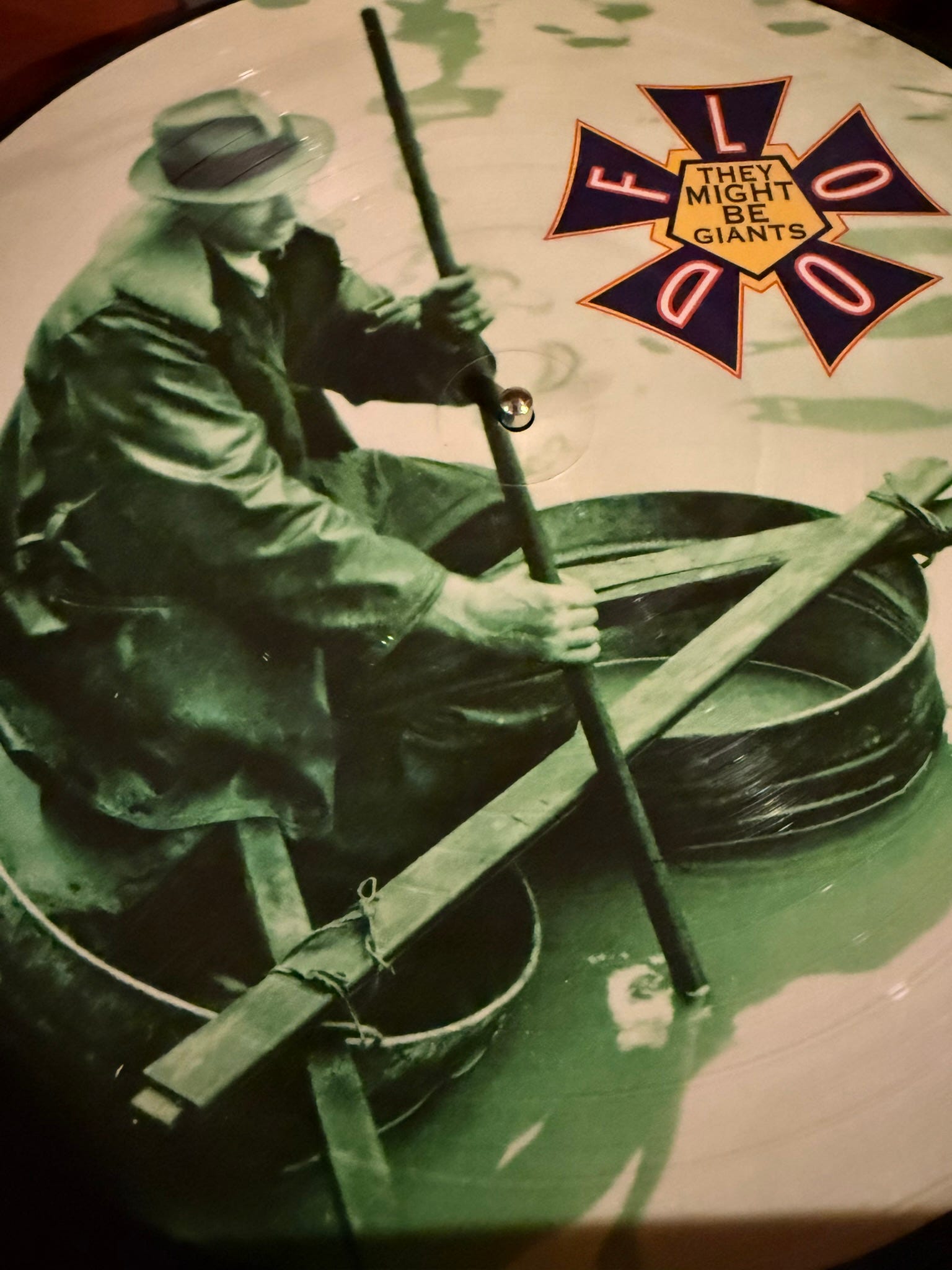
Let’s consider the title, the cover, and the first track. Flood–it would be hard to choose a more biblical name. The flood invokes Noah and the rebirth of all humanity through God’s judgement and mercy, the world’s first baptism. The cover image of a man on a raft concocted out of buckets is comic and yet suggests something serious. Is this the end of the world? Or a new beginning? Or just a goofy ride? The first track strikes a hopeful note drenched in irony. “Theme from Flood” is a brief, showtune style throwback to an earlier time, recorded as if playing from an old vinyl record complete with scratches (even when played on a new vinyl record):
Why is the world is love again? Why are we marching hand in hand? Why are the ocean levels rising up? It’s a brand new record for nineteen ninety.
They Might Be Giants brand new album . . . Flood.
Parodically self aggrandizing, this 27 second introduction to the album lets us know a few things. 1) This is not like any other album you have listened to. 2) We are going to be off balance, not everything here is going to immediately make sense. 3) There are some serious themes here and 4) we are going to have some fun.
Not bad for 27 seconds of music.
Track 2. Birdhouse in Your Soul
Did They Might Be Giants coin this term? Or is it more ancient? Could The Hillbilly Thomists be referencing an older medieval tradition of birds taking up hay and straw based residences in the human psyche? I don’t know. I suspect TMBG is the source of the reference, however, and even if they didn’t coin the term, I am quite sure that they are the intended reference from The Hillbilly Thomists. This one also starts by making sure we are off balance, beginning with quiet, atmospheric accordion tones and a quiet, nearly too quiet, voice saying, “I’m your little friend, I’m not your only friend, I’m a little glowing friend but really I’m not actually your friend I . . .” This borderline coherent ramble is interrupted by the drum beat and aggressive accordion styling that will drive the song as if to say, that’s enough of that, we are on to something else now. At the last minute and at great expense we have decided to play a different song. Then we get the iconic “real” opening line of the song: “Blue canary in the outlet by the light switch, who watches over you Make a little birdhouse in your soul.”
If the title and the opening track brought us images of the past, here we know we are in the electrified present. This canary is a nightlight, a bird in an outlet by a light-switch. But he has something to say. Like something out of a dream, this plastic plugged-in bird can talk:
I have a secret to tell
From my electrical well
It’s a simple message and I’m leaving out the whistles and bells
So the room must listen to me
Filibuster vigilantly . . .
The song could be titled, “meditations by a night light,” and includes the only rock and roll reference to the filibuster that I can recall and also references “the Longines Symphonette,” “Jason and the Argonauts,” and eventually, “Guardian Angels.” The lyrics are borderline nonsense, but there is a heartfelt appeal to making space in the soul for one thing, “say I’m the only bee in your bonnet” . . . but what? The light itself? They leave that a mystery while recognizing the need to prepare our soul for something. That’s big. Layer that powerful if mysterious sentiment on top of a compelling beat, an irresistible accordion lick (if there is such a thing), a growling saxophone solo, endearing (is nasally) vocals, and you have an all time great song.
Flood consists of 19 tracks (Nineteen!) only three of which clock in at more than three minutes long. Here are a few notes some of the remaining tracks that may have some resonance for the Catholic imagination.
Track 3. Lucky Ball and Chain is a meditation on a lost love that drives home the error of abandoning marriage for convenience, pride, or any apparent good. “I lost my lucky ball and chain and now she’s four years gone. Five feet tall and sick of me and all my rambling on.” More than a breakup song, this is a song that confronts divorce, “There goes the bride as she walks out the door,” and hinges on the lament, “I was young and foolish then, I feel old and foolish now.” Pro marriage, anti-divorce—These might be Thomists after all.
Track 4 Istanbul Not Constantinople is a cover of a song from the musical Chess. I haven’t seen that musical so I don’t know what we might be able to pull from that reference, but it certainly suggests an awareness of the ongoing cultural struggle between East and West, even while couching that struggle in humorous terms: “So if you’ve got a date in Constantinople, She’ll be waiting in Istanbul.”
Track 5 Dead appears to be a consideration of reincarnation set to a simple piano accompaniment. It is bleak yet mesmerizing and catchy. Reincarnation is probably the wrong word, however, as this is a most unusual version of “coming back again” I have heard: “I came back as a bag of groceries accidentally taken off the shelf before the date stamped on myself.” Reincarnation isn’t a Catholic thing, of course, but it is clear we aren’t expected to take the scenario literally. The song considers a ceremonial execution (a martyrdom? Perhaps, but we get no context to know with certainty) and ponders two tragic possibilities for life and death: “Now it’s over. I’m dead and I haven’t done anything that I want, or I’m still alive and there’s nothing I want to do.” Memento mori vs the deadly sin of acedia, an epic battle.
Track 6 Your Racist Friend leans into a 1990’s style morality tale about race. It’s got an infectious groove, a brief hard rock style guitar solo followed by a Mexican themed horn breakdown, and ultimately concludes that “You can’t shake the devil’s hand and say you’re only kidding.” The Devil is real and on that TMBG and THT would agree.
Track 7 Particle Man goes back to basics with an oom-pa-pa feel that feels, well, ridiculous, and that feel is matched by lyrics that are absurd to the point of profundity. “Particle man, Particle man doing the things a particle can . . . Is he a dot or is he a speck? When he’s underwater does he get wet, or does the water get him instead? Nobody knows. Particle Man.” Eventually we meet other characters, triangle man, universe man, and person man. There are fights. Triangle man always wins (a nod to the Trinity?). What does this all mean? We may have to ask The Hillbilly Thomists as I have no idea but it is great fun.
The rest of the album includes many other standout songs and continues to jump through genres and moods, presenting the serious, the silly, the profound, and the ridiculous in thoughtful and varied musical arrangements, something that might appeal to a writer like (the original Hillbilly Thomist) Flannery O’Connor, a certain kind of Dominican Friar, or a Glad-Trad Gen-X Dad™.
Here’s a link to the full album Flood on Spotify.
*They Might Be Giants have released more than twenty albums since 1990, and I have not listened to them all. Still, I am pretty sure this is the best one.