
Pope Leo XIV recently addressed representatives of the film industry, providing brief remarks about the purpose and value of film. He also shared a list of four of his favorite movies.
The address is not long and worth reading. It can be found here at the Vatican website.
Highlights include his call for filmmakers to reject producing movies based on an “algorithim”—the approach that tends to limit what movies are produced to those few that are most likely to (but frequently do not) bring in huge dollars. It is why Hollywood is so risk averse, and why it seems like every film today is a sequel (Toy Story Five, I am looking in your direction). Here is Pope Leo:
The logic of algorithms tends to repeat what “works,” but art opens up what is possible. Not everything has to be immediate or predictable. Defend slowness when it serves a purpose, silence when it speaks and difference when evocative. Beauty is not just a means of escape; it is above all an invocation. When cinema is authentic, it does not merely console, but challenges. It articulates the questions that dwell within us, and sometimes, even provokes tears that we did not know we needed to express.
This is a terrific prescription for filmmakers and can serve as a guide for viewers too. Looking for movies that are not “immediate and predictable,” films not afraid of “slowness” or “silence.” Can we find movies that use beauty not as “escape” but as an “invocation?” These are great targets when selecting movies (or any art).
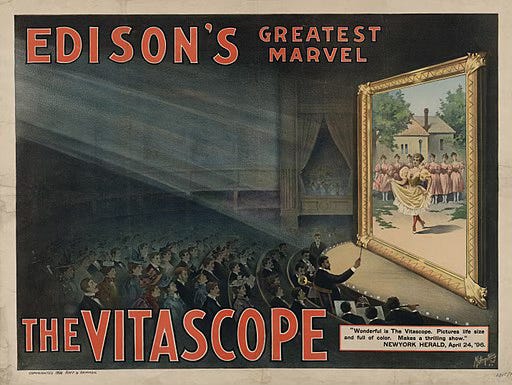
He also specifically notes the merits of watching movies at the cinema as a community experience. He noted that while we are surrounded by screens, moviegoing can help remedy isolation. There is merit to stopping to watch something together:
Entering a cinema is like crossing a threshold. In the darkness and silence, vision becomes sharper, the heart opens up and the mind becomes receptive to things not yet imagined….
Am I wrong or do Pope Leo’s words seem to reference the opening to The Twilight Zone?
There is a fifth dimension beyond that which is known to man. It is a dimension as vast as space and as timeless as infinity. It is the middle ground between light and shadow, between science and superstition, and it lies between the pit of man’s fears and the summit of his knowledge. This is the dimension of imagination. It is an area which we call… The Twilight Zone.”
Sorry. The Pope continues:
. . .Cinemas are experiencing a troubling decline, with many being removed from cities and neighborhoods. More than a few people are saying that the art of cinema and the cinematic experience are in danger. I urge institutions not to give up, but to cooperate in affirming the social and cultural value of this activity.
Seeing a film on the big screen is a worthy endeavor, but one that I partake of rarely (once or twice a year, maybe). I wonder if deliberate movie viewing groups that watch together, but in a home, would also meet Pope Leo’s definition of a cinematic “institution.” That is something that seems viable (and affordable) for families and friends to continue to “cross a threshold” together. No doubt this is better than doom scrolling in isolation, even if it means watching together on a laptop screen.
In an interview shortly before his address to filmmakers, Pope Leo provided a list of four of his favorite films. Two might be considered predictable, It’s a Wonderful Life (1946) and The Sound of Music (1965). Both are great movies but they are two that you might have come up with if asked to guess, “what would the Pope (particularly an American Pope) say are his favorite movies?” I haven’t seen Ordinary People (1980), so I am not sure what to make of that selection, but it is now on my watchlist. His last selection, Life is Beautiful (1997), is a favorite of mine and a more unexpected pick. A screwball sometimes-comedy about the holocaust, this film can achieve Pope Leo’s vision for cinema at its best:
When cinema is authentic, it does not merely console, but challenges. It articulates the questions that dwell within us, and sometimes, even provokes tears that we did not know we needed to express.
Life is Beautiful is not a safe or obvious pick. It won three academy awards and was nominated for seven, but it is a challenging, almost experimental, film in its willingness to stare into the heart of darkness with the eyes of a slap-stick comedian. Depicting a father’s attempt to guide his son through life in a nazi death camp, director and lead actor Roberto Begnini walks an artistic tightrope and, improbably, succeeds. It manages to produce genuine laughs, moments of terror, tenderness, and can “provoke tears we did not know we needed to express.”
While the absence of a Coen Brothers films in this list is problematic, I look forward to Pope Leo’s next four film recommendations.