
In August of 1944, as allied troops we’re advancing towards Paris, Hitler ordered the entire city to be rigged for explosion. As German troops retreated from the city he famously asked his commanding officer, “is Paris burning?”
General Dietrich von Choltitz did not burn Paris, but many people are asking the same question today. There are scenes of riots that are deeply disturbing, especially to those of us with family in France.
What is going on?
It all started on September 17 when teachers went on strike at a high school in suburban Paris. When we think of suburbs we think of wealthy, green and pleasant lands. In France, as in much of Europe, the suburbs refer to what we would call housing projects. That’s much more the context of the initial teachers’ strike.
It is not unusual, even here, for students to turn out in support of their teachers. Who doesn’t like a good day off in the autumn?
The particular problem in France is that all of these issues cross a number of contemporary and historical tripwires. For one, protest in France has a long and proud tradition. Students turning out to protest is taking part in an important part of French political culture. It was a riot and subsequent storming of the Bastille that marks the beginning of the French Revolution. And it is that day of riot that is still celebrated every year.
It would not the an exaggeration to say that, for the French, rioters hold the same kind of historical resonance as do the Minutemen of our own revolution. Most Americans at the time of the French Revolution were horrified by what happened. The Minutemen did not support what happened.
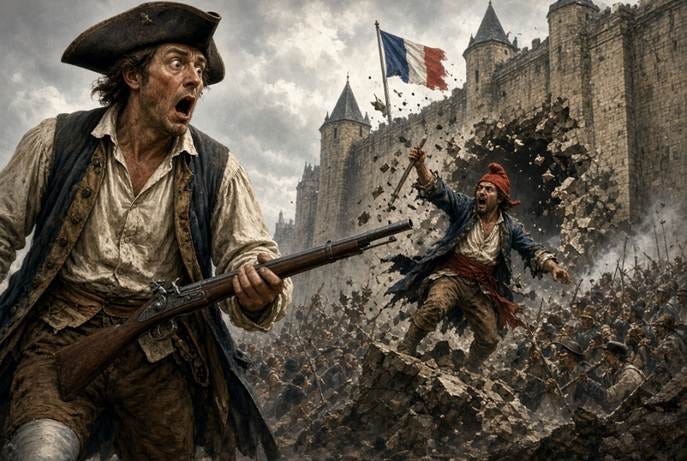
The French, and especially the French left, are very much nostalgic for their rioting forebears. So there is a smiling indulgence when students riot. Even more, some think that rioting students are the real heart of the Republic.
There is a long tradition of protests that look a lot like riots in France, and the French are kind of used to them. There is a sort of standard way of protesting and rioting that we might not understand. Below is a frame from a video from a previous protest/riot in France where people sit at a café while thing burn in the background. (I love this.)

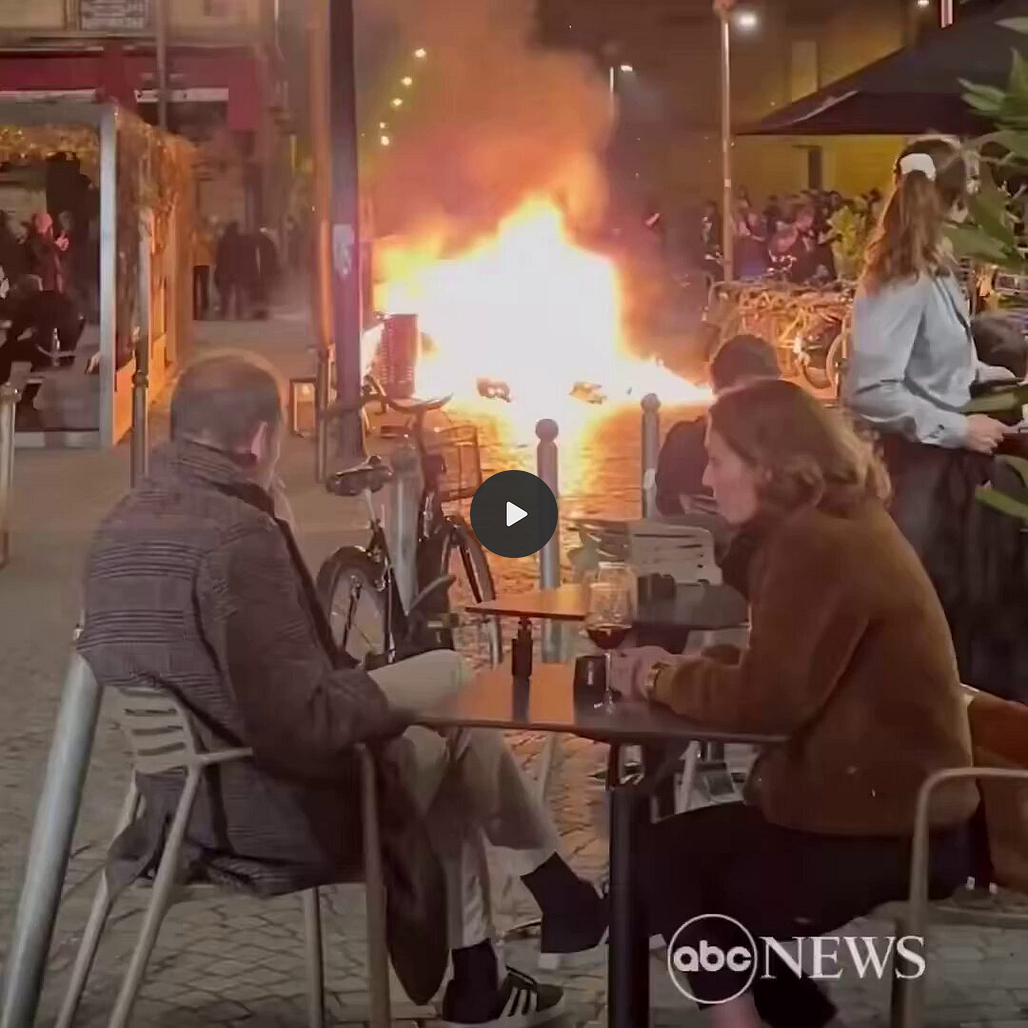
/video/1
But we have to add to this, too, that there is a deep racial and religious divide in France that also coincides with the geography of the suburbs. A very large part of the population in those low-income suburbs are Arab and African immigrants or their descendants. And the vast majority of them are Muslim. France has the highest Muslim population of any European country (apart from some Baltic states that were occupied by the Ottomans for centuries), so this is a lot of people. Numbers are a little hard to determine, however, because collecting racial and religious information is not permitted in France.
We have talked before about the red-green alliance, the political alliance of the far left (red) and Islam (green).
Note: The American Republican party was never associated with the color red nor the Democratic party with blue until, really, the year 2000 when the electoral college map was up on TV throughout the Bush-Gore recount. Before that time there was no standard color. In 1972, the first time a TV station could do this in color, the Republicans were blue and the Democrats were red. Red has always been the color associated with the left, ever since the French Revolution.
When protests, and even a little bit of friendly rioting, are seen as a patriotic duty and all this gets combined with a deep divide in the country, bad things are liable to happen. And when the protests start in poor, Muslim areas of France, the whole thing takes on a religious and ethnic quality that has a life of its own. There are many videos now of people making radical Islamic statements at what started out as just a strike about teacher pay.
Add to this that a national election is scheduled for next year. All political parties have an incentive to capitalize on these protests and riots, and they are trying to do so. Already the far left has publicly supported the protestors (not necessarily the rioters) and the far right has denounced them (trying to elide the distinction between protest and riot).
Where will this go? The usual process is that the protests start to die down as people get tired and the ringleaders get arrested. Politicians use the events to boost their side, but most often the left gets to spend more money.
The money issue is underlying all of this. The French government is deeply in debt (as are all, but more so) and has few areas in which it can raise taxes. Even parties on the right don’t want to cut services, as a generous state is considered a defining feature of French republicanism. Also, as a member of the European Union, there is only so much that a state can do to influence its economy.
So, with economic issues largely blunted because taxes could hardly be raised any higher and cuts are not an option, the distinction between the parties comes down to a cultural divide. And that divide is on display right now. Last week the Pope visited France with massive events that were universally peaceful. This week we have people calling for jihad in some of the same locations.
Just to rub salt in the wound, Israeli officials have suggested to France that they embrace a two-state solution. Recall, France was one of the few countries to recognize a Palestinian state (whatever that might mean) after the October 7 atrocities of three years ago. Harsh but fair.
One last thing. Europeans and Canadians are often frightened by the fact that Americans can own firearms. They think that people are shooting each other every day. They think you have to duck leaving your front door. We know that isn’t true. Maybe in some areas, but not in most.
In the same way, the protests and riots in France are confined to very specific areas. Paris is not burning. Those of you who know someone who is living in Versailles will be pleased to know she has travelled in and out of Paris many times in the last two weeks and has been very safe.