
“Down to the River to Pray” is the second song in O Brother to be performed on screen by the characters, giving the film the quality of a musical. Here our trio have found a spot to rest in the woods and enjoy a roasted gopher or two (or a whole village). As they do, they are surrounded by a procession of white robed penitents slowly walking toward the river as they sing:
As I went Down in the river to pray
Studyin’ about that good ol’ way and who shall wear
The starry crown God Lord, show me the way
O Fathers let’s go down
Let’s go down come on down
O Fathers Let’s go down, down to the river to pray
One by one they head into the river where they are greeted by a pastor who baptizes them, leaning them back and dunking them underwater. They emerge, process back to shore and continue to sing. As the dozens of figures pass around our trio in song, Delmar, Pete, and Everett look on with varied reactions. Pete is stunned. Everett is confused. Delmar is taken. He can’t look away.
Everett has the group figured out, he thinks, “I guess hard times flush the chumps. Everybody’s lookin’ for answers.” This is the second time Everett has brought up this idea of “looking for answers.” It was also his explanation for why Mrs. Hogwollop up and “R-U-N-N-O-F-T.” The need to find “answers” in the world (or outside of it) will come back again later as well.
Delmar has no such skepticism. Before Everett has finished reducing the event to athiestic snark, Delmar darts into the water lurching with wild arms (in a clear homage to Buster Keaton), stepping to the front of the line and receives his baptism. The moment is the most decisive act by Delmar in the film. Earlier, when confronted with a conflict between Everett and Pete, he astutely avoids picking sides and indicates, “I’m with you fellas.” Now, he breaks away from the trio as if drawn by a power beyond himself. We hear the pastor utter the proper form of the baptism as he approaches, “ . . . Father, Son, and Holy Ghost.”
In this critical moment, just after the preacher says “Holy Ghost,” the camera breaks free from the stability it has had so far in the film. Cinematographer Roger Deakins allows the camera to take a God’s eye view, far above the action. The lens flies down from directly over Delmar as he sinks under the water, providing a first person view of the Holy Ghost’s descent to join Delmar through the sacrament.
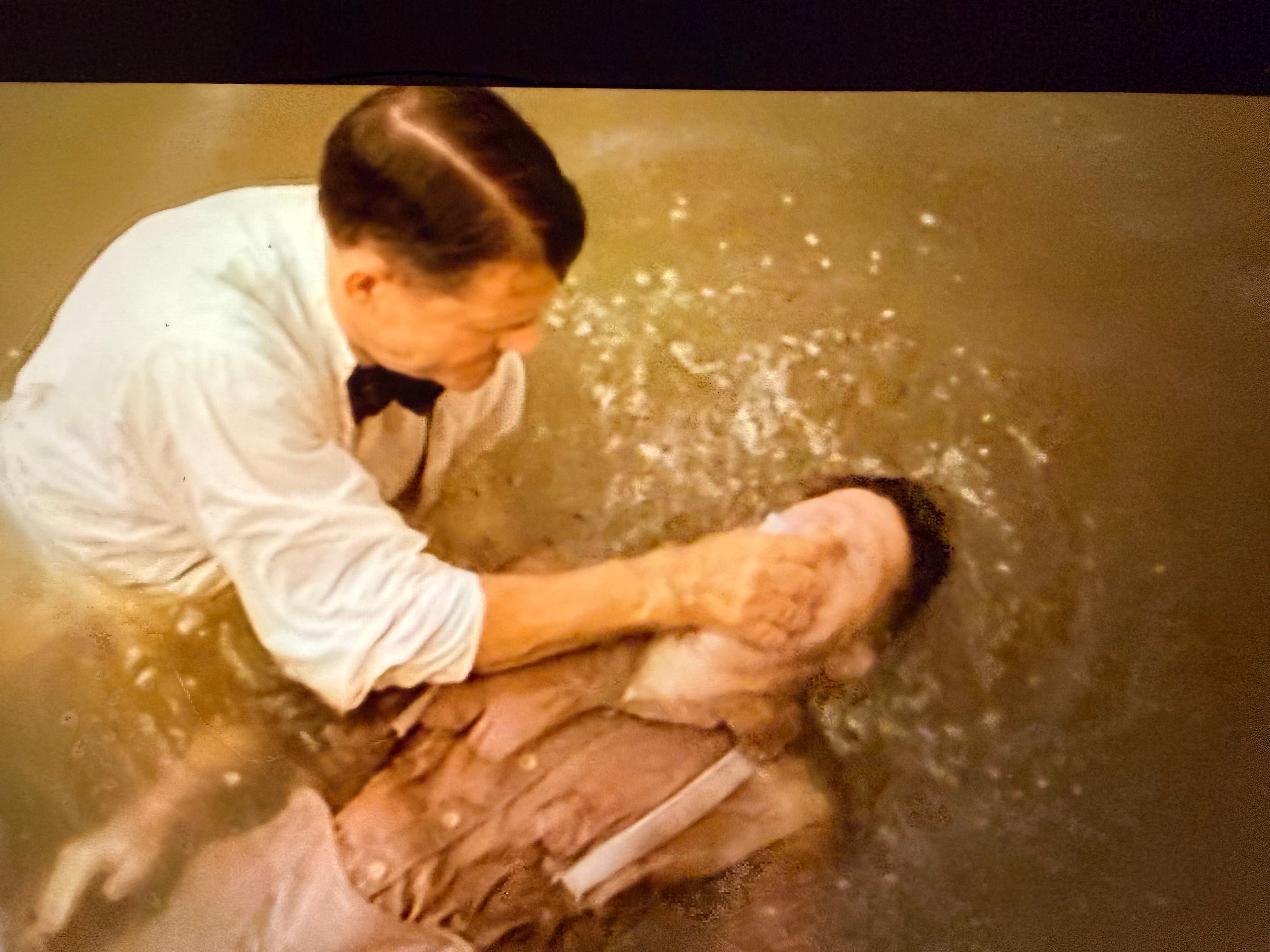
Pete (the Rock) immediately recognizes what has happened, “Well I’ll be . . . Delmar’s been saved.” Delmar is converted by the experience. He tells us so, “it’s the straight and narrow for me from now on” and he implores his friends to join him, “Come on in boys, the water is fine.” He has become an evangelist. Pete takes him up on the invitation and scrambles in to be baptised too. Later we will see additional evidence that Delmar has taken this conversion seriously and is attempting to live up to his Christian promises (see the upcoming post on “I’ll Fly Away”).
The song continues to tell part of the story we are watching, a story sinners called to prayer and repentance. This moment sets up an important conflict in the film, the conflict between Everett and God. He calls the congregation “chumps,” and calls Delmar and Pete “dumber than a bag of hammers” for thinking baptism has any kind of merit.
The song reminds us again of the title with a verse that begins “O Brother”
O Brother let’s go down
Come on down, don’t you want to go down
O Brothers let’s go down
Down to the river to pray
After cycling through fathers, mothers, sisters, and brothers, the song concludes with an appeal to all, “O Sinners lets go down . . . “ an appeal to conversion, calling all sinners—all people—down to the river to pray. This includes Everett, but he does not respond to the call. In fact, he leans into his skepticism. This critical conflict is established here, Everett vs. God, or Everett vs. Faith in God. Everett is a thoroughly materialistic man with no need for the backward “ignorant” “superstition” of Delmar and Pete. It also provides the background for the second great conflict in the film, man vs the law. The use of this song and the characters reaction to this moment creates a kind of dramatic triangle between God, man, and the law. Shortly after their baptism, Delmar and Pete need correction on this point. They believe that their redemption through baptism should also absolve him of their worldly crimes. Pete says, “The preacher said it absolved us” and Delmar says, “There was witnesses that seen us redeemed!” Everett corrects them, “Even if it did put you square with the Lord, The state of Mississippi is a little more hard-nosed.” Everett is right about the state of Mississippi, and—unknowingly—about the wages of sin. There are temporal punishments ahead.
As the scene concludes, we get a final paradoxical summation of the situation from Everett: “Baptism! You two are just dumber than a bag of hammers” but his rejection of their faith is punctuated with an invocation of Christianity again, “I guess you’re just my cross to bear.” Everett accidentally invokes the most Christian of images in his attempt to reject God and the importance of faith in the world. The call to prayer and call to conversion has brought Everett to consider taking up his cross and following Christ—even if he doesn’t realize it.
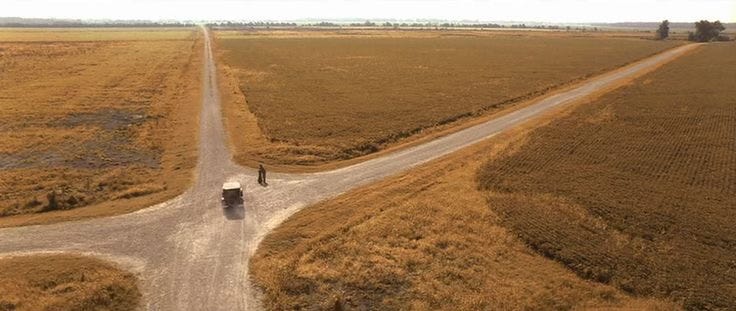
This encounter with a preacher, baptism, and a literal discussion of the merits of baptism brings them to a crossroads, a literal crossroads where they will pick up a man who has sold his soul to the devil to learn to play the guitar “real good.” The echoes of the call to conversion, the call to go “down to the river to pray” will hang heavy in the air as their adventure proceeds.
Next up, “Man of Constant Sorrow.”