
“You are my Sunshine” plays briefly in O Brother, Where Art Thou? It is heard while Pete, Everett, and Delmar sit in the living room of Washington Hogwollop, Pete’s cousin, after they have been freed from their chain-gang chains. It will be heard briefly again toward the end of the film. “Po Lazarus” and “Big Rock Candy Mountain” revealed the grand cosmic aims of this adventure, the quest for heaven lurking beneath the goofiness of the film. “You Are My Sunshine” points to the personal heartbreak—and the politics—that are also on display under the slapstick antics.
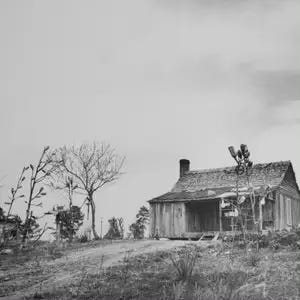
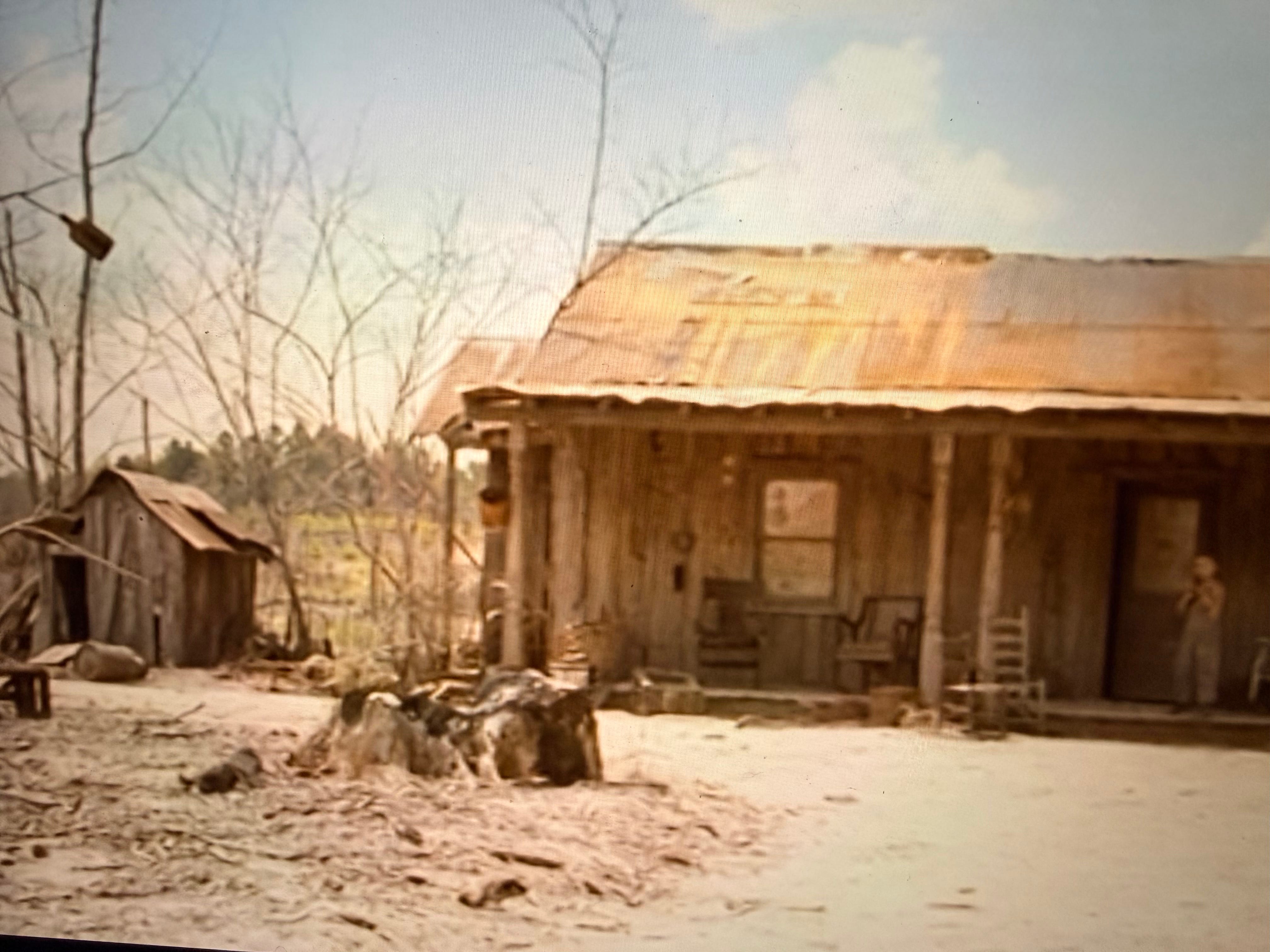
Washington Hogwallop is a loaded name that signals political elements of this film are about to unfold. “Washington” calls to mind George Washington as we observe a slice of America in the midst of the depression. The set design of Wash’s house is modeled on the 1941 photograph by Eudora Welty, “House with Bottle Trees,” part of her collection of photographs depicting the Southern poverty.
Welty’s Photo:
Wash’s House in O Brother:
Wash’s wife, Cora (“heart”), has left him. Remember the title, O Brother Where Art Thou? Is taken from Preston Sturges film Sullivan’s Travels about a filmmaker attempting to make a film about the plight of the poor. Washington Hogwallop presents America as the poor, bereft of heart (“good riddance” he says of Cora) and reduced to physical and moral degradation, eating his horses and betraying his kin.

Like “Po Lazarus,” and “Big Rock Candy Mountain, “You Are My Sunshine” tells another version of the story we are watching, here it is the tale of a lover who has been left behind. The full lyrics could apply to Wash, as his wife up and “R-U-N-N-O-F-T.” Everett knows why she left, “She must have been looking for answers.” Perhaps this is projection, however. The story of “You Are My Sunshine” could be Everett’s as well. We will soon learn he is trying to reunite with his wife before she marries another:
The other night dear, as I lay sleeping
I dreamed I held you in my arms
When I awoke I was mistaken
I hung my head and I cried . . .
You told me once dear you really loved me
And no one could come between
But now you’ve left me to love another
You have shattered all my dreams . . .
In all my dreams dear, you seem to leave me
When I awake my poor heart pangs
So won’t you come back and make me happy
I’ll forgive dear, I’ll take all the blame
Despite the sad tale, the familiar chorus repeats the persistent feeling that this love is still treasured and eternal:
You are my sunshine, my only sunshine
You make me happy when skies are grey
You never know dear how much I love you
Please don’t take my sunshine away.
These lines provide a glimpse inside Everett’s head, but we don’t hear them in the film—only on the soundtrack album. While watching the film, we only get the chorus once from Wash’s radio before the song concludes and we hear the voice of Pappy O’Daniel, host of the “Pappy O’Daniel Flour Hour,” the owner of Pappy O’Daniel Flour, and—we later learn—the current sitting Governor of Mississippi. We also later learn that his first name is Menelaus, a name pulled from The Iliad and The Odyssey—the man who launches the Trojan War. In the film he is part of a great conflict between political factions in the form of his campaign for re-election. The “civil” political war that serves as the backdrop of Everett’s adventure brings the stakes of the film out of the spiritual and strictly personal, and into the political as the future of Mississippi is at stake.
Earlier, we were alerted to watch for names when the trio got a ride from the blind “seer” on the railroad pump car.
Delmar: “Work for the railroad old timer?
Blind Seer: “I work for no man.”
Delmar: “Got a name do ya?”
Blind Seer: “I have no name.”
Everett: “Well, that right there might be the reason you’ve had trouble finding gainful employment. You see in the mart of competitive commerce–”
Everett knows that names matter. He will later have to fight to preserve the name of his daughters and his wife who are about to become “Warvey gals.” What of the other names in O Brother?
Ulysses Everett McGill (George Clooney), our main character, gets the unlikely name Ulysses, pulled from the world of The Odyssey even as he stomps around Mississippi. “Ulysses” is the Latinized version of the name Odysseus used in England and Ireland. It was adopted by James Joyce as the title for his twentieth century adaptation of The Odyssey set in Ireland. Clooney’s character is not called Ulysses, however, only “Everett,” with Old English roots meaning “Wild Boar,” capturing something of the madcap persistence and courage required for his journey. “McGill” is perhaps the most interesting. From either English or Irish, the name means either, “son of a stranger” or “son of a servant.” He will later sing that he is just a “stranger” in “Man of Constant Sorrow,” and he is a man of several disguises like Odysseus himself.
Peter Hogwollop (John Turturro) and Delmar O’Donnel (Tim Blake Nelson) form the pair with whom Everett must navigate this adventure. Rough (very rough) stand ins for Scylla and Charabidis, Peter—like Scylla–means “The Rock” and Delmar (Del = “of the,” Mar = “Sea”) references Charibyds, the deadly whirlpools. But there is nothing deadly about Delmar. In fact, he seems pure and innocent (except for that PigglyWiggly he knocked over). “Of the sea” calls to mind Mary, the star of the Sea, and Delmar’s demeanor is much more like Our Lady than that of a deadly whirlpool. Similarly, Peter “The Rock” is not like a sea monster set out to destroy Ulysses, but he is a devoted, loyal follower, like Peter from the Gospels, and one who—like Peter from the Gospels—will betray his promises before the film is over. It seems Everett, then, is not threatened by a sea monster and a whirlpool, but aided by Mary (Delmar) and a Disciple (Pete). Everett is on a personal quest that places him in the center of a political conflict and it all seems to carry cosmic weight.
“You Are My Sunshine” is a sentimental, personal song, but it appears in the film as the stage is being set for a more-than-personal story. The song itself had political associations in real life. “You Are My Sunshine” was first published by Jimmy Davies who became “The singing” Governor of Mississippi in 1944. There was also a real life flour-selling “Pappy” O’Daniel who was governor (and later Senator) of Texas in 1939.
At this point in the film, our trio has been freed from their chains, fed, cleaned up, and ready for a night’s rest. Their slumber will be disturbed however, after Washington turns them in to the “thora-TAYS!”
“They got this depression on. I got to do for me and mine!” Wash justifies himself. Everett and crew—now in a “tight spot”— must go on the run again, from the law and from an otherworldly pursuer without a name, a menacing figure with fire in his eyes—and a mean old hound dog.

Next up, “Down to the River to Pray”