
Perfect Days could be described as a movie in which nothing happens. But this is not Seinfeld, not a “show about nothing.” It is a show about something important and difficult to put on screen. I’m not sure I have to put a “spoiler alert” up for this film since almost nothing happens—but for the record, I will be discussing many elements of this film, from the beginning through to the ending.
That said, this is a movie in which a man drives around listening to great music on audio cassettes, cleans toilets, and interacts with a few (very few) people. There is not much to it and very little “happens.” That said, it is profound and beautiful and worth watching (probably multiple times). It is like few other movies I’ve seen (maybe only one*). Watching this film, I could not help but think of the Fifth Joyful Mystery of the Rosary, the Finding of Jesus in the Temple. For that decade we typically pray for the grace of “Seeking God in All Things.” There is nothing explicitly Christian in this film but it certainly is a kind of prayer for that—seeking God in all things.
After the end credits the film introduces the term “Komorebi,” “Komorebi: The shimmering of light and shadows that is created by leaves swaying in the wind. It only exists once.”
The film features many images of shadow and light at play among leaves. Occasionally these images appear superimposed over other images as well but they are so obscured as to be a mystery. The main character, Hirayama (played by Koji Yakusho), pauses each morning to smile at the light filtering down to his simple apartment as he heads out to work for “The Tokyo Toilet” where spends his days cleaning public bathrooms around the City. As he drives from bathroom to bathroom, he selects specific cassette tapes to listen to along the way, creating a soundtrack for the film and for his life. He takes his lunch break in a park where he takes photographs of the light filtering through the trees each day. Hirayama’s appreciation for these small moments of beauty point us toward a way of understanding the film. How can we find beauty in the interplay of light and shadow–and music, particularly the particular moments that are happening . . . now.
“Next time is next time. Now is Now” Hirayama sings at one point as he rides his bike alongside his niece in a rare moment of human connection. This is not a superficial call to “Carpe your Diem” but a sincere appeal to see the beauty in all things.
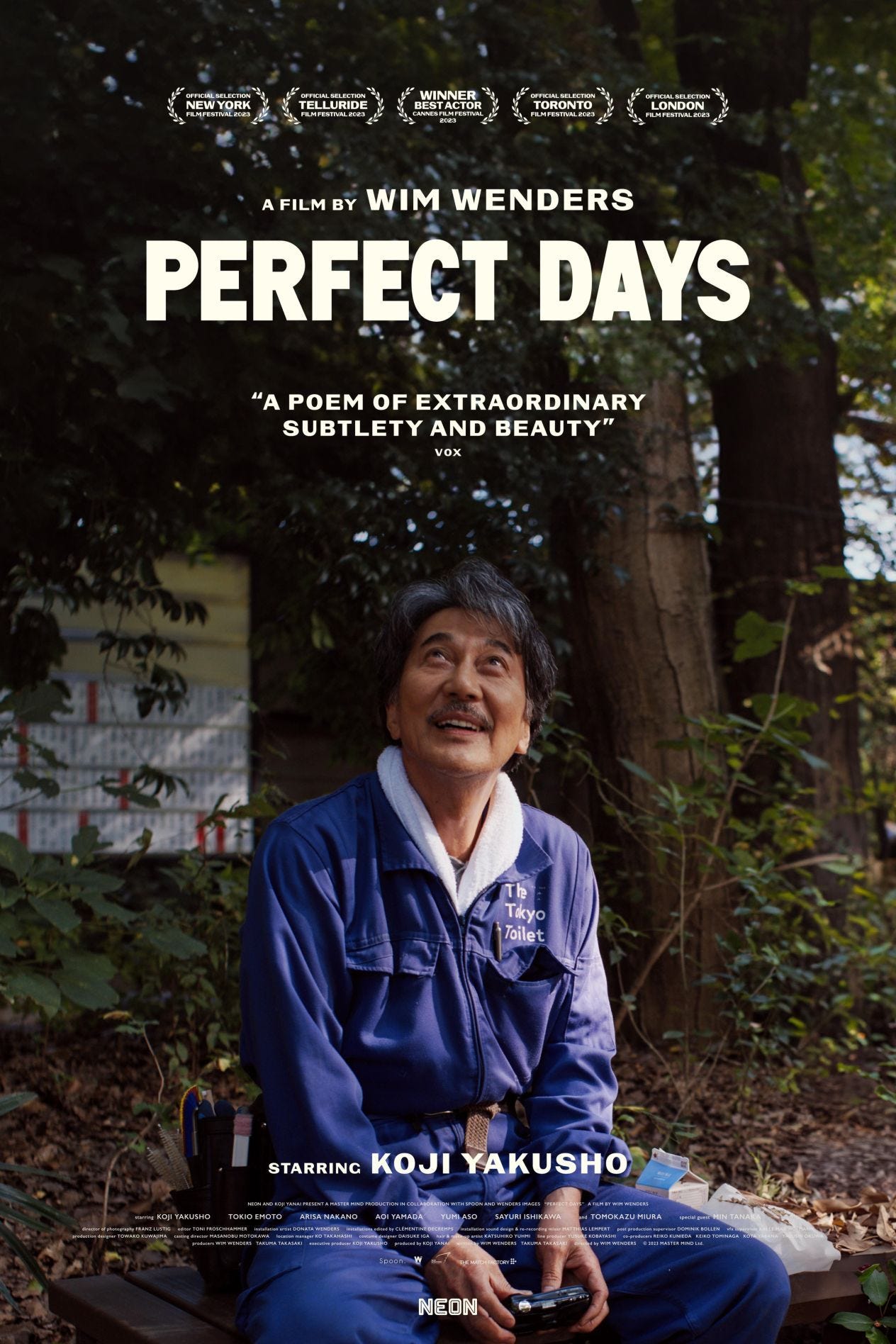
The light and darkness in the trees is eventually put in perspective of the light and darkness in the lives of the characters, but never in jarring or grotesque ways so common in modern cinema. The light and dark of human life is left off screen, and more as question than depictions. We see the confused relationship between Hirayama’s coworker Takashi and his love interest Niko. We learn of Hirayama’s distance from his sister and his mysterious unwillingness to visit his father. We do not learn what is behind these strained relationships or how they resolve, but we know there is darkness lurking there. We also know there are hints hiding in the music we hear, from “House of the Rising Sun”by The Animals to “Redondo Beach” by Patti Smith to “Perfect Day” by Lou Reed to the concluding scene that unfolds to Nina Simone’s “Feeling Good.” The music is a character—and a compelling one—and provides a fun energy and additional mystery to the film throughout.
For all his appreciation of the beauty in his life, there is no doubt that Hirayama is profoundly alone. He is genuinely shocked (as we are) by the few moments of human connection he experiences in the form of appreciation for his actions from Niko and his niece, or when he realizes there may be something more to his unstated attachment to his favorite bartender. We see him surprised by the joy of playing tic tac toe with an unseen bathroom correspondent. He delights in these connections even as he refuses to acknowledge anything is missing in his life. The conclusion of the film shows him connecting with a stranger/new “friend”, a similarly aged man who is also alone. They share a touching moment of fun, playing “shadow tag” while trying to learn if shadows multiply, do they get darker together?
The final moments of the film consist of more than two minutes with the camera trained on Hirayama’s face while he drives and listens to Nina Simone’s song, “Feeling Good.” Light and shadow filter over his face revealing a range of emotions. We see his characteristic smile, one we have seen several times each morning, but as the light and shadows flit across his face, he also experiences sadness, distress, his eyes well with tears. All these emotions are interrupted by smiles too, as if he is both experiencing the emotions and able to observe them as more moments of light among the leaves. The shadows that fall on his face are so dark at times we think the film will fade out to credits but the scene continues much longer than seems possible. The scene works and is the culmination of an amazing performance by Yakusho throughout the film.
If this all sounds heavy, the film is not. It feels light and is full of energy despite its pace. Part of that energy comes from the interpolations of great music. Perfect Days has a perfect soundtrack, one that is hand picked by Hirayama himself.
Here is a link to the playlist of those songs. They are better when heard in the context of the film however, which is currently available free via Kanopy if you have a library card.
Content warnings: None. Not for kids, but not because of anything inappropriate, just not a kids movie.
*The only other film I can name that is at all “like” this one is Jim Jarmusch’s Paterson, a similarly paced and similarly themed film about a poetry writing bus driver (played by Adam Driver) named Paterson in Paterson New Jersey which is also worth watching multiple times.