
I can guarantee there will be no spoilers in this review for the singular reason that I have not seen the movie. This is a “title” review only, not a movie review. But due to federal regulations that require all media outlets to comment on the new movie Project Hail Mary, I am doing my part with this review of the title, “Project Hail Mary.”
First impressions: This is a terrific title. Three simple words that evoke a range of profound associations and reactions. Let’s consider them. We will deal with “Project” last. First we consider, “Hail Mary.” This powerful choice hits home. It is a phrase with grand cultural and spiritual significance. Here in deeply Catholic Massachusetts, when people hear those words in that order, “Hail Mary,” they immediately elevate their minds to reflect on…Doug Flutie.
In 1984, with less than ten seconds to go in their football game, the Boston College Eagles were down 45 to 41 to the Miami Hurricanes. Facing swirling winds and positioned just past midfield, diminutive Boston College quarterback Doug Flutie, dropped back another 15 yards and launched the ball 60 plus yards through the air where it fell into a crowd and ended in the hands of his roommate, Gerard Phelan, who—fortunately for the Flutie—was also on the Boston College Eagles football team, resulting in an improbable victory for BC and an enduring memory for many of what may be the most iconic “Hail Mary” pass in college football history.
The concept is simple. This situation is so bad, and a good outcome so improbable—perhaps even impossible—that your only option is to turn to God for help. Years of elite athletic training, countless hours of practice, coaches’ agonizing study of game film are all worthless at this moment and you must turn to—Gasp!—Prayer. “Hail Mary” has come to mean attempting to overcome a hopeless situation. The phrase was often deployed when describing these plays at Catholic colleges, like Notre Dame and Boston College.
But it is not simply throwing up “a prayer” but specifically a “Hail Mary.” Wouldn’t throwing a prayer be enough? Asking for the intercession of St. Jude, Patron saint of lost causes, for instance, would also be appropriate in these situations, so the desperation pass play could be called the “St. Jude,” but we have the “Hail Mary.”
There is no better model for participating in the impossible than Mary. The first two lines of the Hail Mary describe the most impossible thing that has ever happened, God becoming Man:
Hail Mary, full of Grace, the Lord is with thee
Blessed are thou among women, and blessed is the fruit of thy womb, Jesus.
Ripped from the headlines of the year zero as reported in the Gospels, this singular fact of life, that God came to dwell on earth as a baby Mary’s womb, is the most profound and singularly inexplicable thing to have ever happened. One could charge that applying it to a football game walks the fine line between homage and blasphemy, but I think we can embrace the enduring power and cultural relevance of this distinctively Christian (Catholic) prayer. Long embraced by football fans, the term “Hail Mary” now has cultural relevance outside of football, often used to describe any desperate attempt to accomplish something with a low chance of success.
This brings us back to the title of the new film directed by Phil Lord and Christopher Miller, who are known for their previous work on the surprisingly terrific Spider Man Into the Spiderverse, the bafflingly good product placement film The Lego Movie, and the inexplicably amazing adaptation of the nonsense children’s book, Cloudy with a Chance of Meatballs. Here they are adapting a novel by the same name, Project Hail Mary, written by Andy Weir (who also worked on the screenplay for the film). I do not know if there is an explicit reference to the actual prayer in the film (as I have not seen it). While I suspect a character will say the words “Hail Mary” in the movie, I highly doubt that there is a moment when a character gives voice to the subsequent words “full of grace” or “fruit of thy womb, Jesus.” There is an even slimmer chance that anyone says the second half of the prayer, “Holy Mary Mother of God, Pray for us sinners now and at the hour of our death.” The title, nonetheless, stands as a cultural marker of the enduring importance of this most powerful of prayers. This film could have been “Project Long Shot,” “Project No Chance,” or a cringey “Project Dream Big,” or “Project Never Give Up.” Weir could be accused of having conceived of the title by trying to think of synonyms for “Mission Impossible.” Weir landed on “Hail Mary.” The filmmakers doubled down on that, and I am grateful for that. Since the Angel Gabriel uttered those words and ever since Christ performed his first miracle at the request of Our Lady at Cana, there has been great power and mystery carried by those words, “Hail Mary.” This major motion picture is both reminding us of (and capitalizing on) that power and mystery. We could take a cynical read on that decision, but I’m going the other way. Three cheers for continuing and expanding the presence of the Hail Mary in the popular consciousness. The producers are leaning into this association with the latest movie poster in fact, which has made “Believe in the Hail Mary” the tagline for the film. Adding “believe” to the mix further suggests a genuine connection to the prayer.
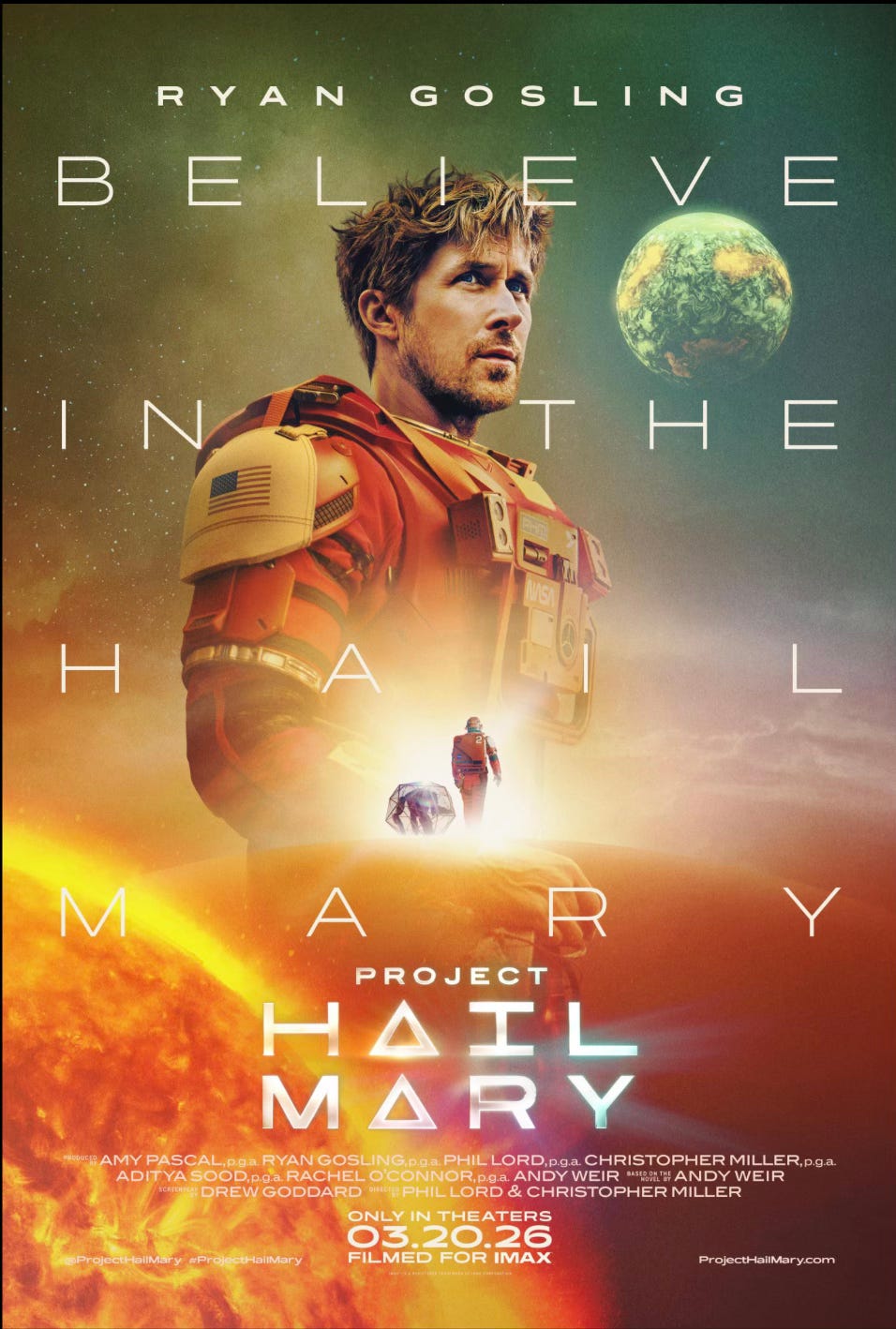
What about the first word of the title: “Project”? As a word, it is a loser. Few like a project. It invokes work, long effort, and . . . planning. No thank you. “Project” also contradicts our typical expectations for a situation requiring a “Hail Mary” on or off the football field. Doug Flutie’s Hail Mary was an emergency. No time for planning and preparation, just drop, pray, and chuck. A “project” that requires the Hail Mary is something else, a kind of contradiction—so bonus points for mystery. Finally, we should note that “project” also means to send out far and wide, as in “project” your voice to the audience. Perhaps the double meaning was intended? Is the film here, in part, to “project” the Hail Mary further into our popular imagination, memory, and practice? That would be a long shot, I know. Some might even call it a Hail Mary.
Although you're generally a more well-informed person than Donald Trump, this post sounds like Trump reviewing a book that he hasn't read. With all due respect, of course. To you, not to Donald Trump.
More seriously, my eldest daughter gave me this book for Christmas and while I almost never read science fiction, this book was an absolute banger. I would definitely you read it. I haven't see the movie, but the book is fantastic.