
In the late eighties, amidst what would become something of a boom in Contemporary Christian Music (CCM), there arrived the unexpected, a genre of music so improbable it will make music historians pause and tilt their heads in disbelief for years to come: Christian glam rock. And by Christian glam rock, I mean Stryper. Comprised of four men dressed in outlandish yellow and black striped leather outfits, adorned with the big hair and the attitudes associated with the bands Poison or Motley Crue, Stryper attempted to bring a Christian message to the world through the medium of glam rock (I will spare you the picture). Their albums “In God We Trust” and (Grammy Award nominated) “To Hell with The Devil” had some near-hit songs that no one can remember today. They made the big time in the mid-eighties/early nineties, selling millions of records and touring the world. I can’t know how many souls were brought in proximity to Christ through their glam-rock antics, but the fundamental medium/message disconnect in their project produces that wincing cringe and laughter we experience today as we contemplate the cultural phenomenon that was Christian glam rock.
“What are you even doing here?” Stryper’s music is forced to ask of their message—and vice versa. The band probably had to hire separate tour buses for them to avoid getting into fist fights. The problem with the “Christian rock” approach was expertly captured by a comedian who quipped, “You aren’t making Christianity better, you’re making rock and roll worse.”
It is often the case that the attempt to make the nominally Christian version of some popular art diminishes both the art and the message. Frontloading the message risks driving the artistic enterprise into the ground. There are (few) exceptions to this rule, however, and they are found when the medium and the message are better aligned than glam-rock/Christian-message pairing.
This brings us, of course, to the Hillbilly Thomists.
The history of the Hillbilly Thomists stretches back well before their first album in 2017. In the early 1200s, St. Dominic established the Order of Preachers that still exists today, the Dominicans (known as—via a latin pun made not by his dad, surprisingly, but by his mom—Domini Canes, the Dogs for Christ).

Some 800 years later, a group of faithful Dominicans grabbed some instruments and launched a popular bluegrass music group as part of their preaching the Gospel to the world. Would it be a cringey embarrassing enterprise dragged down by the weight of its own (eternal glory) mission? Would this be Stryper in a Dominican habit?
No. No it would not. It would be among the finest additions the bluegrass genre. The Hillbilly Thomists appeared on the scene in 2017 and have released four albums filled with fine a-pickin’ and a-singin,’ as well as a-beauty, a-truth, and a-goodness.
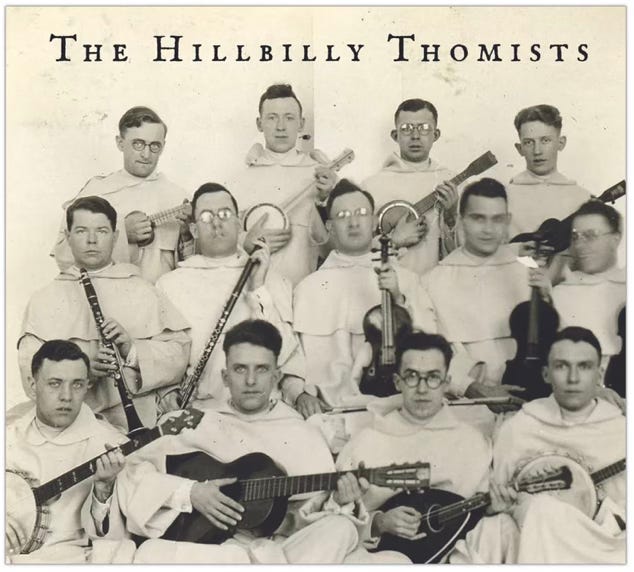
The name “Hillbilly Thomists” is taken from Flannery O’Connor who said of herself, “Everybody who has read Wiseblood thinks I’m a Hillbilly Nihilist, whereas I’m a Hillbilly Thomist.” Not grotesque and shocking like many O’Connor stories, the Hillbilly Thomists’ music—like O’Connor’s work—faces the darkness and reminds the listener of the presence of God’s grace in the world. Through expertly crafted versions of iconic folk songs like “Poor Wayfaring Stranger” and “Angel Band,” the Hillbilly Thomists participate in American folk music traditions that stretch back to the mid 1800s. Both of those songs keep death before our eyes and ask us to reflect on our final destination.
“I’m just a poor wayfaring stranger, traveling through this world of woe,
yet there’s no sickness, toil, nor danger, in that bright land to which I go.”
Or from Angel Band:
“I know I’m near the holy ranks of friends and kindred dear.
I hear the waves on Jordan’s banks, the crossing must be near”
With their original songs, the traditional sound and structures are so authentic, I have to check the credits to determine if it is a new song or one they learned them from a blind centagenarian on a mountaintop, or if they pried them out of the earth after moving an old stump. The highlight of these originals is the covid-era inspired lament (or celebration) “Bourbon, Bluegrass, and The Bible.” It features an outlandish yet catchy banjo line and an irresistible chorus:
“Death’s in the air and it’s gone viral.
Everybody’s talkin’ about a new revival.
When it’s a question of love and survival:
Bourbon, Bluegrass, and the Bible”
The verses let you know that the song has its sights set well beyond covid hysteria. Yet, the chorus brings a smile as well. There is levity lurking in that banjo line and those lyrics. They bring a distinctively Catholic, and Dominican, character to the songs. Another highlight of their original work is the Dominican battle cry, “I’m a Dog.”
“I’m a dog with a torch in my mouth for my Lord.
Making noise while I got time.
Spreading fire while I got earth
How You wish it was already lit.
Give me Your fire,
I’ll do Your work.
I’m just a dog for my Lord.”
These are in-your-face Christian lyrics and potentially cringeworthy in the wrong setting. This is some heavy stuff, but ensconced in well-crafted traditional American folk music, it is a burden that seems light. Layered with banjo, fiddle, and down-home harmonies, these songs just work. They feel authentic because they are rooted in music that has always been used to sing about God, grace, and our final destination.
They didn’t have to force Christ into old-timey folk music because He has always been there. Bluegrass folk is a welcome canvas for a literal pairing of a Christian message and popular art. At the same time, the Hillbilly Thomists avoid taking themselves too seriously, as there is playfulness found throughout their recordings. “Heaven or Tennessee”, “Way Down in New Orleans”, and “Chasing Money No More” all bring levity to the music and the message. Even at their most pensive and personal, listen to “Old Highway,” for instance (a meditation on starting a new life “in a Chevrolet”), we believe the songs are sincere and that they—and we—are supposed to be having fun with them.
As we begin November, the month of the dead, we reflect on those we have lost and ponder our own mortality. As we confront the four last things: Death, Judgment, Heaven, and Hell, the Hillbilly Thomists can be fine companions along the way. As you build your eschatology playlist for this year (you do do that, right?), here are some Hillbilly Thomists (and no Stryper) songs to include as well as a link to my Hillbilly Thomists Best of playlist.
Angel Band
Wayfaring Stranger
Bourbon, Bluegrass, and the Bible
Weight of Eternal Glory
I’m a Dog