
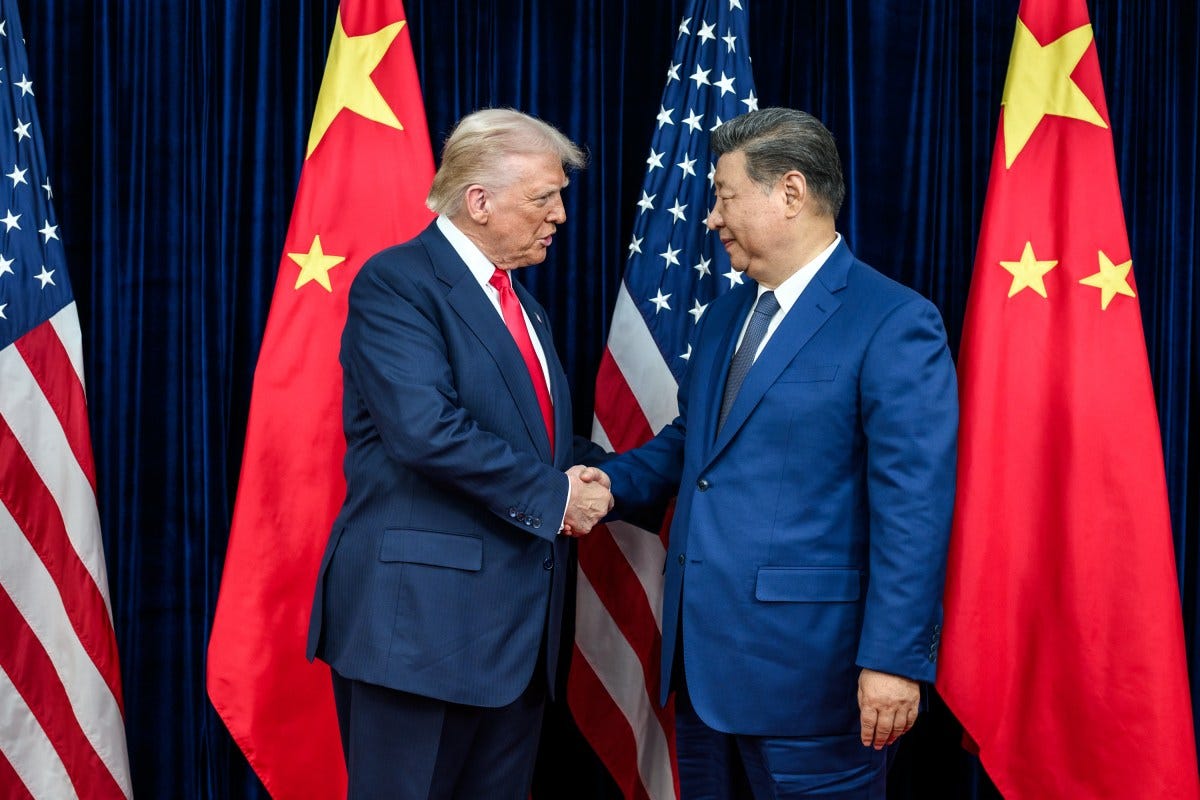
The President is visiting China this week, which is a major deal. A presidential trip is a logistical nightmare, regardless of where he might be going. There are something like 60 different vehicles that have to go with any president. The President leaves this afternoon, but there are a lot of American personnel there right now taking care of security.
China presents extra complications. All people traveling with the President will have to leave all their electronic devices at home. China hacks all phones the moment they are turned on in their country and take all information into their spy services.
There are several big issues on their agenda.
Economy and Trade
China and the US are the two most important economies in the world and both are under pressure from the war military engagement in Iran. China is officially a Communist country, but it has had a somewhat free market since Deng Xiaoping opened its market economy in 1978.
This has accelerated remarkably under Xi Jinping, the current leader. His legitimacy is bound up with the amazing rise in the Chinese economy. The problem is that the economy is slowing down. Part of this is a feature of current events, but much more has to do with intrinsic issues within the Chinese economy.
China’s economy jumped to world prominence because it could provide American and European corporations very cheap production facilities. China was willing to build any factory under any conditions, ignoring environmental regulations we impose on ourselves. They have a highly educated and disciplined workforce that has been developed over thousands of years of Chinese culture. The Communist regime is also indifferent (as all Communist regimes have been) to the working conditions of their people. China became the sweatshop of the world.
But Xi has been trying to transition the economy to higher profits and higher-end products. The most important of these at the moment are its electric vehicles. They are being produced well below the price of any others in the world and are flooding markets in Europe. The US is trying to keep them out of the country, not only to protect its own car manufacturers.
Electric vehicles are among the most sophisticated machines ever made. Part of their sophistication is the array of sensory abilities and video recording, both used in self-driving capabilities. But to make self-driving work, they have to send this information back to the home company. That means every Chinese car is recording full time every road, every light, every person walking down a street, every business, police car and every piece of infrastructure in the country. You don’t have to be paranoid to get suspicious.
Much of China’s rise has come at the expense of the US economy and the economies of other western countries. Almost everything that was once made in the USA is now made in China. Trump wants to reverse that, so there is an inherent tension between the two countries. His promise to his voters has been that he would undo the offshoring of industries that have hollowed out the industrial center of the country. There has been a little progress in that regard, but not a lot.
Strait of Hormuz and Iran
President Trump is under pressure to get the war over with and get gas prices down because he is facing a midterm election in November. The bombing of Iran has not been popular with the American people and the polls show that. How much longer can he hold on to this policy? That’s the question for Trump.
Premier Xi isn’t under any electoral pressure, but most of his country’s oil and gas comes from the Middle East. To keep the economic miracle of China going, which is his only claim to legitimate rule, requires that he gets the spice gas flowing. As a key ally, perhaps the key ally, Xi will have a lot of influence with Iran. If China abandons the mullahs, they have no one to turn to.
Diplomacy between China and the USA could end the blockade of the Strait of Hormuz. That would be a great economic relief to both parties, but probably a bigger diplomatic win for Trump than Xi. Opening the Strait would mean abandoning another Chinese ally. After the uncontested arrest of Maduro from Venezuela, China would not look like much of a friend.
But does Xi care? In an era of power politics when nations are sorting themselves out into regions, what does friendship mean? Survival is the question.
Russia and Ukraine
The US and China are allies to the opposite sides in this war, but each in a tepid way.
The US abandoned Ukraine to its own devices when Russia was preparing to attack in 2022. Pres. Biden removed all Americans from the country, more or less giving his go ahead to Putin to invade. (He should have sent Harris over there and dared Putin to attack a country with a sitting vice president visiting.)
China hasn’t done much to help Russia except buy its oil at a discount. Not really huge support. More like taking advantage of the situation.
So in a way the two major powers on earth are spectators of this conflict, and it is easy to see why. Would China want to go to war with Ukraine and, theoretically, Europe to fulfill Putin’s historiographic argument about where the people of the Rus began? Unlikely.
And the American position has traditionally been to allow Russia to wear itself out. Both China and the US are also gaining invaluable information about new ways of war, especially drone warfare.
Europe has the real interest in all of this, but it is hard to see what outcome would be best for it. A Russian victory would not be good and would scare them. But a Ukrainian victory (whatever that might look like) is hardly better. When Europeans can barely field a few tanks on a weekday, do they really want over 100 battalions of battle-hardened Slavs taking a victory lap?
Taiwan
The elephant in the room—or the dragon—is Taiwan. In 1949, the losing side in the Chinese Civil War fled to the island of Formosa. The leader of the Nationalists, Chiang Kai-shek, set up his government on the island and changed its name to Taiwan. It was officially recognized as “China” at the United Nations until 1971, even sitting as the permanent member of he Security Council. Martial law was in effect on the island until 1987 and it did not have its first presidential election until 1996. In the meantime, it became the most important semiconductor manufacturing center in the world. (Don’t ask me how.)
It has always been an ambition of the Communist Chinese to take back the island and reunite the Chinese people. As with all Communist revolutions, China quickly changed its way of motivating its people from visions of worldwide revolutions to blood and soil patriotism. Taiwan stands as affront to these ideas.
The US has held an ambiguous position towards Taiwan. The US won’t call it “China” and it won’t declare that we will go to war to protect the island, but we have troops stationed there and a whole lot of naval assets hanging around. Will we or won’t we? That’s the question.
The Taiwanese are in an awkward place. China and the US get their most sophisticated chips from them. That’s another reason why China wants it and one of the main reasons America protects it. But as the US returns industry to the country (and there is a big Taiwanese chip manufacturer setting up here), Taiwan become less important to Americans.
Xi could be thinking about letting more factories return to the US to make Trump happy but also weaken American ties to the island. Would he abandon Iran for this? Could his economy sustain the hit? This is what statesmanship is about.