
Redistricting is in the news because the state of Texas has decided to change the map of its districts in advance of the midterm elections in 2026. This is a little unusual, but not illegal in Texas. The result, however, is almost certain to change the partisan breakdown (i.e., how many are Republican and how many are Democratic representatives) in favor of the Republicans who control both houses of the Texas legislature and the governorship.
In response, Gavin Newsom, the governor of California, wants to do the same for his state, but in a way that will benefit his party, the Democrats. The problem he faces is that California has a very strict law about this. Redistricting in California is not done by the politicians of the state but by a board specially appointed for this purpose. Moreover, they can do this only in appointed years. Gov. Newsom is forced to ask the voters of the state through a referendum or ballot initiative to allow him to change the rules in this one instance. Newsom wants to cancel-out the advantage Texas might give the Republicans, especially because he is currently the most likely candidate for the Democratic nomination for president in the 2028 election.
What Is Redistricting?
Every member of the House of Representatives represents a geographical location, a district. The number of representatives was fixed at 435 in 1929, so as the population has grown from around 120 million in the 1920s to over 350 million today—and some states have grown a lot more in that time than others—those 435 seats have had to be redistributed a lot.
For instance, Vermont had two House seats in 1929 but only one today. There are more people in Vermont now (around 650,000) than back then (about 350,000), but California grew much more, from fewer than 6 million in 1929 to almost 40 million today. Vermont didn’t quite double its population while California increased by almost seven times. Vermont now has only one representative, so there is no “districting”. The whole state is one district of about 650,000 people. California, however, and most other states, have to find a way to distribute their seats so that there is a rough equality of population for each district.
Let’s take the Commonwealth of Massachusetts as an example. Massachusetts has 9 House districts. How would you divide up the state? Putting a sheet of graph paper over the map of Massachusetts would not work. There are far more people in the Boston area than there are in Western Mass. Equal geographical districts would produce wildly unequal districts based on population.
What if you changed the size of the grids? Make one huge grid for the western part of the state and a few little grids for the east. That might work. But what if your grid cut across a river, the Charles, say, and 90% of the district was in Boston and 10% in Cambridge. Is that really a geographical district? Would candidates bother to go all the way over there for only a few voters? And imagine how difficult it was 200 years ago. So, the logical thing is to follow the course of the river and give that 10% to a district north of the Charles and maybe find a way to even up the district on the south side. But now you’ve messed with the grids. Is that OK? Sure it is. The legislature is in charge and can make them any shape they want. Really? Oh yeah!
Because each legislature (but not in California, as mentioned above) can change the shape of a district, there is a strong temptation to change the shape to favor whatever party is in charge at the time. Again, think of those 9 House districts in Massachusetts. Currently all nine are held by Democrats, which is likely because the majority of voters vote Democrat. But in the 2024 Presidential election 36% of the state voted for President Trump over Vice President Harris. If 36% are Republicans, shouldn’t at least one of those nine House seats go to a Republican? Not really. Each district holds its own election. If you divide all of them up so that there is always a Democratic advantage (60% Democrats in each district), Republicans can never win. Legislators have been accused since the beginning of the Republic of doing just that, changing the shape of districts to make sure their party, or even a particular member of their party, wins easily every time.
What Is Gerrymandering?
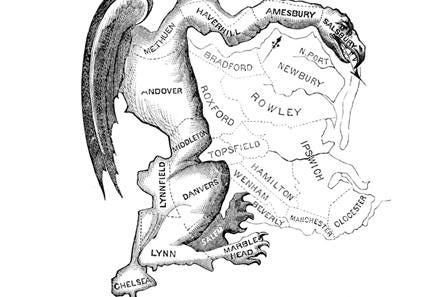
Enter Elbridge Gerry of, yes, Massachusetts. Gerry was a delegate at the Constitutional Convention but is most famous for giving his name to the practice of designing the shape of a district for partisan advantage in 1812. He did not design it, but as governor he signed the bill that mapped out the districts. Somewhat more confusing, this was not a map of Congressional House districts, but state senate seats. Nevertheless, the term “Gerrymander” was so perfect that it has stuck and is even used in other countries.
Opponents of the new map said it made a district look like a salamander. This became “Gerry-mander” after the governor. Below is the map as it appeared in Boston papers of the time.
Why Is This Important?
Redistricting is a Constitutionally mandated function of government. If we did not do this, Vermont would still have its two representatives and California would have eleven instead of the 52 it does today. That’s a big change and only fair as populations change and people move around the country. But it isn’t really keeping with the ideas of the Founding. The Constitution originally mandated one representative for every 30,000 people. By that measure, Vermont should have 21 House seats, but the total of seats in the House would be over 11,000!
But don’t forget that redistricting is also about politics. Whoever can gerrymander to their party’s advantage will gain power for that party at the Federal level. What power in particular? Well, all money bills, meaning things like taxes, must originate in the House, so that’s a very powerful position.
But more importantly at the moment is the fact that the House has the exclusive power to impeach a president. The Senate conducts an impeachment trial, but only after the House moves first. Given how much most Democrats hate President Trump, if they were to win the House they would impeach him for the third time. The Republicans currently have the majority, but it is small. It wouldn’t take many gerrymandered seats to flip the House next year and hand it to the Democrats.
Is that likely? No. There are not many states where gerrymandering will help the Democrats. California might get four or five extra seats, but only if Newsom can convince a majority of voters to change the law. Even then, people looking at the various states agree that most Democrat-run states have already done as much gerrymandering as they can. Think about how Massachusetts doesn’t have any Republican representatives. Republican states, on the other hand, have not been as effective to this point. If they got ruthless, they could flip as many as 20 seats in their party’s favor.