
***Note: Welcome to our new readers—many courtesy of the recommendation from the great Phil Lawler! Subscribe to his Substack if you don’t already. Thank you, Phil. You can learn more about Dad News Network here at our “about” page. A key point is that there are a few things going on here. Some news summaries and commentary, and some . . . other stuff. This post falls under the “. . . Other Stuff.” Much more importantly, though, you should stop what you are doing and get a copy of Phil’s new novel, Ghost Runner, which is available at Sophia Institute Press and Amazon. End of Note***
We recently learned of the dramatic operation ordered by President Trump to capture Venezuela’s Communist leader Nicolas Maduro for drug charges which reminded many of a similar effort ordered by President Bush to capture Panama’s leader Manuel Noriega for drug charges in 1990. In 1990, however, Noriega was not extracted by a delta force in the dark. After a military operation, he was forced out by blasting rock and roll music at the building where he was hiding. Supposedly The Clash, Guns N’ Roses, and Van Halen’s classic, “Panama,” were instrumental in ending the standoff and apprehending Noriega.
What music might have been used for Maduro’s capture? Trump was watching the stealth operation live. Perhaps a White House staffer queued up a soundtrack? Creedence Clearwater Revival’s “Run Through the Jungle” and Blondie’s “One Way or Another”? And did Biden have a song in mind when he issued the original bounty for Maduro? Perhaps he stared at a portrait of the communist crime boss while spinning Pink Floyd’s “Wish You Were Here.”
Speaking of “Wish You Were Here.” This brings us to the much neglected topic of parenting and Pink Floyd (“of course it does” -ed).
One important role for Pink Floyd in parenting comes in the form of a bedtime song, specifically “Fearless,” from the Album Meddle (1971). This song has been frequently deployed as a bedtime song for more than twenty years (well, in our home at least). It has a terrific balance of story, mystery, and a sleepy, yet singable, melody. I don’t recommend attempting to sing the cool guitar strumming part or the Liverpool soccer stadium anthem found on the studio version, however.
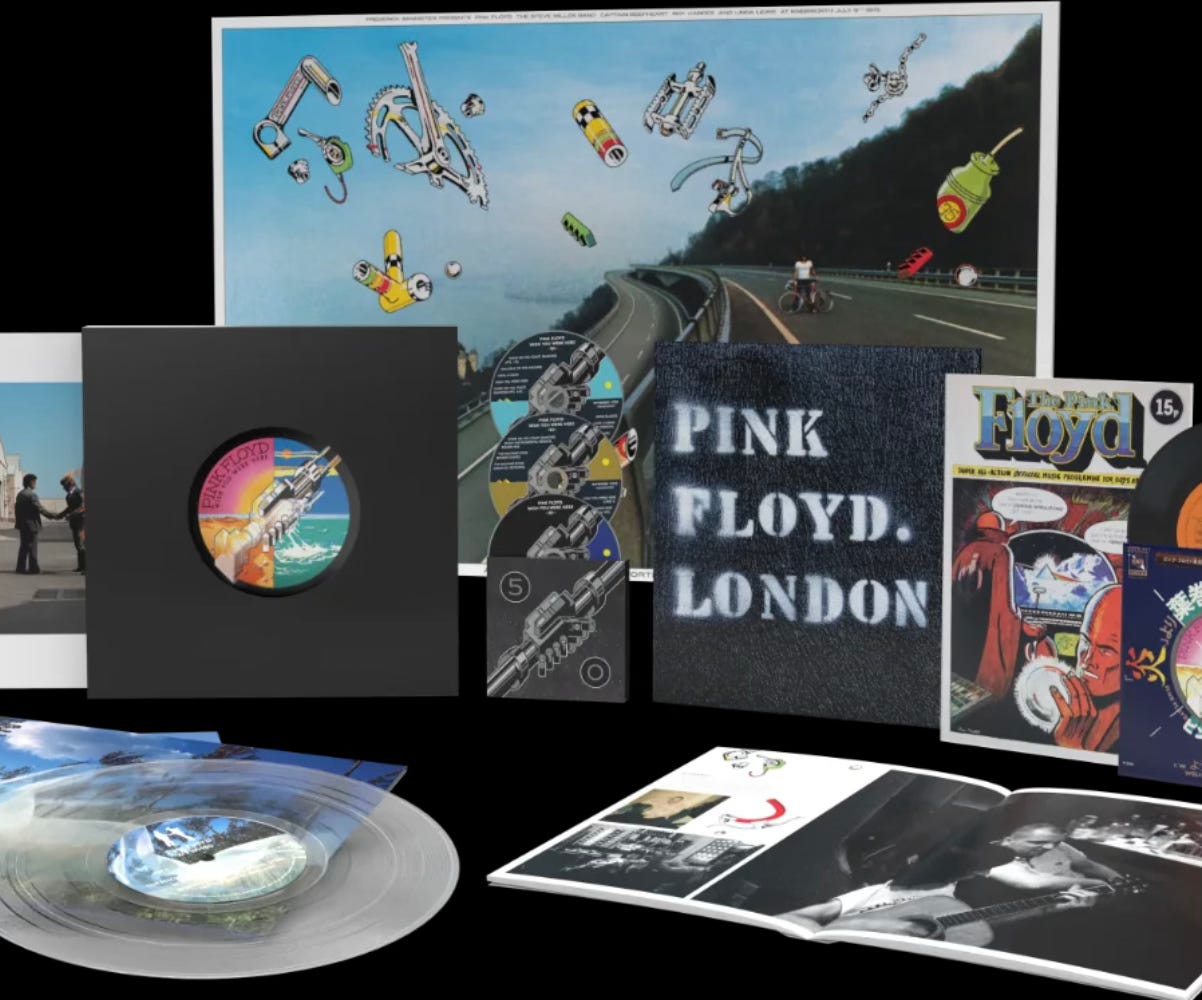
In December, Pink Floyd released a 50th anniversary edition of their 1975 album, Wish You Were Here. The new edition includes bonus tracks, live tracks, books, posters, and other assorted merchandise. Despite my years of listening since the 1990’s (and attendance at two concerts), the band neglected to send me an advance copy for review, forcing me to take a different approach to discussing this release.
The album is generally seen as a critique of the music business and a tribute to their eccentric former band mate, Syd Barrett. The album has only five tracks. Two are clearly about the music business, “Welcome to the Machine,” and “Have a Cigar.” The other three (“Wish You Were Here” and the two parts of “Shine On You Crazy Diamond”), the bulk of the listening time of the album, are tributes to and reflections about Syd Barrett. As a result, the overall sentiment of the album is that of reflection on a relationship, not a long lost love, but a familial connection, like a parent looking back on the life of his child.
Pink Floyd’s place in rock and roll history is cemented due to their epic works—sweeping, grand “concept” albums that tell a story or dive into a single theme. Several members of the band were architecture students before turning to music full time, and their drive to “build something” is tangible in their music.
These grand creations did not come easy. In the early days Pink Floyd struggled with Barrett, their first lead guitar player and primary songwriter. Wildly creative, he was notoriously erratic and difficult to work with (in no small part due to his use of psychedelic drugs). The difficulties eventually led the band to hire a steady second guitar player (David Gilmour) to cover for him on stage. Barrett wrote lesser-known Pink Floyd “hit” songs like these three:
“The Gnome,” a Tolkien-informed portrait of, well, the life of a Gnome:
I want to tell you a story about a little man, if I can.
A man named Grimble Grumble.
And little gnomes stay in their homes.
and “Bike,” a Dr. Seussian/Monty Python-ian tune that cycles through unrelated silly poems while appealing to his love, “I’ll give you anything, everything . . . if you want things”:
I’ve got a bike.
You can ride it if you like.
It’s got a basket, a bell that rings,
and things that make it look good.
…
I’ve got a mouse, and he hasn’t got a house
I don’t know why I call him Gerald.
and “Astronomy Domine,” where, well, your guess is as good as mine:
Blinding signs flap,
Flicker, flicker, flicker blam, pow, pow.
Stairway scare,
Dan Dare, who’s there?
Lyrics may not have been his strong suit, but his songs were whimsical, child-like, dreamy, and fun. Pink Floyd’s first record, Piper at the Gates of Dawn (1967), is worth a listen both for the songs and the production value (it was recorded down the hall from the Beatles working on their breakthrough album Sgt. Pepper’s Lonely Hearts Club Band, and both bands were experimenting with and sharing ideas about what was possible in the studio).
Barrett once wasted a day with the band attempting to teach them a new song he called “Have you got it yet?” The band would start to pick up on the chords and the changes but then could not follow because he kept changing the rules of the song. This went on for some time before the band realized they were caught in Syd Barrett’s maze. There were no rules to hold the song together. It went wherever Syd Barrett wanted it to and didn’t have to come back again. It was both a practical joke and a kind of pure improvisation. Barrett’s time with Pink Floyd came to an end not long after. Like Ernie learning “you’ve got to put down the Duckie, if you want to play the saxophone,” Pink Floyd had to part ways with Barrett to achieve greatness. He was replaced permanently by David Gilmour and Pink Floyd went on to flourish and create their great concept records.
Dark Side of the Moon (1973) is an album that considers a human life from birth to death and catalogs the sources of anxiety faced along the way. After beginning with a quiet heartbeat, songs like “Time,” “Money,” “Us and Them,” and “Great Gig in the Sky” attempt to explore the human condition in what may be the most iconic concept album of all time. It is the best selling record of the 1970’s and was on the billboard charts from the time of its release and for another 900+ weeks (more than 17 years) after. It merits re-listening today and holds up as a worthy rock and roll record.
Another of their great concept albums, Animals (1977), appears to take its inspiration from George Orwell, creating an Animal Farm-like political allegory with dogs, sheep, and pigs as the principal players. The song “Sheep” includes moments when the vocal line evaporates indistinguishably into a guitar tone—a studio breakthrough at the time. The other nine minutes of the song are also worthwhile as they sail from quiet atmospherics to rocking guitar licks and back again, all while advancing the dark story of a potential sheep revolution that may well have inspired the much less dark children’s classic, Click, Clack, Moo, Cows that Type.
The Wall (1979) is a whacked out tale of the life of rock and roll star from his boyhood struggles, his rise to fame, and how he is turned—somehow—into a fascist dictator who struggles to hang on to his sanity. The story is a bit of a stretch, but in just over an hour and twenty minutes the album unfolds the entire bizarre tale and includes well-known songs like “Goodby Blue Sky,” “Another Brick in the Wall,” “Hey You,” and “Comfortably Numb.” “Comfortably Numb” highlights Gilmour’s ability to compose a beautiful and memorable guitar solo—the highlight of the song and the album. Despite confusion based on the title, the song is not about recreational drug use and includes heartfelt lyrics:
When I was a child I caught a fleeting glimpse
Out of the corner of my eye
I turned to look but it was gone
I cannot put my finger on it now
The child is grown
The dream is gone
This brings us to the current re-release of Wish You Were Here and parenting young children. Each child is by nature like Syd Barrett playing “Have you got it yet?”—always changing the game, particularly in the early days. An infant may find comfort in car rides for a month or so, only to realize in month five or six that car rides are, in fact, the worst thing that can happen to you under any circumstances, only then realize a few months later that cars can be a terrific place to sleep—or throw up. The changes keep on coming, and the things that seem to work for a while may no longer apply. Readers should refrain from suggesting I am comparing my children to an erratic psychedelic drug user. Let’s be clear. I am comparing all children to an erratic psychedelic drug user. A growing child inhabits a state of near constant change while parents work like an aspiring architect, building structure and stability where a child can flourish.
The majority the album, Wish You Were Here, is made up of the song “Shine on You Crazy Diamond,” which is a lament, a tribute, and a hope that sounds very much like a parent addressing a grown and now-distant child:
Nobody knows where you are
How near or how far
Shine on You Crazy Diamond
And we’ll bask in the shadow of yesterday’s triumph
Sail on the steel breeze
Come on you boy child
You winner and loser
Come on you miner for true and delusion, and shine.
There are many verses like this and many instrumental sections. The song is patient, building epic moments and leaving a lot of room for improvisation when played live.
The the title track of the album, though, is where parents may share most in this analogically-stretched-to-the-point-of-almost-snapping recap of Pink Floyd’s career. “Wish You Were Here,” the song, features a delicate and beautifully layered acoustic guitar part and lyrics full of bittersweet reflection, longing to recapture a time that is gone and opportunities lost. It begins with a crackly vinyl record sound as the guitar enters, first distant and distorted, and then brilliant and clear.
…So, So you think you can tell
Heaven from Hell?
Blue skies from pain?
Can you tell a green field from a cold steel rail?
A smile from a veil?
Do you think you can tell?
Did they get you to trade
Your heroes for ghosts?
Hot ashes for trees?
Hot air for a cool breeze?
Cold comfort for change?
Did you exchange
a walk-on part in a war
for lead role in a cage?
How I wish
How I wish you were here
We’re just two lost souls swimming in a fish bowl
Year after year
Running over the same old ground
and have we found the same old fears?
Wish you were here.
This song and the album spin on the axis of their parent-like relationship with Syd Barrett. Long after he had left the band, they were still thinking about him, recalling the best of their time together and hoping the best for the future—not a bad sentiment for a rock and roll record.
This analogy can only go so far (“That’s a relief” -ed.) but it can go a little further. Syd Barrett was a man-child that became incapable of growing up, stuck in his own dreamlike world. Children, thankfully, are different. Our little Syd Barretts turn into David Gilmours eventually, they learn to thrive in the family structures and even build them themselves. We get to navigate from the mysterious days of “Have you got it yet?” to the inevitable days of “Wish You Were Here.”
Here is a playlist including Pink Floyd highlights mentioned above and a few of the tracks off one of their live records, Delicate Sound of Thunder.
Good stuff. I’m not sure if I should be impressed or baffled by the fact that you did a full review of Pink Floyd without mentioning Roger Waters once.