
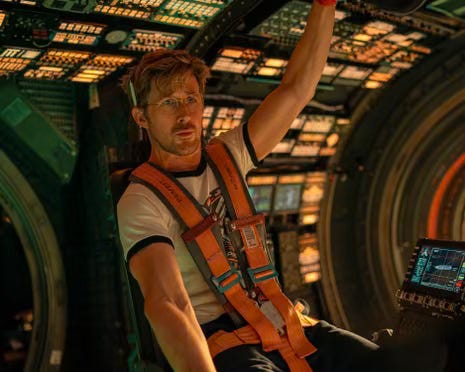
I speculated a couple weeks ago in my review of the title—just the title—“Project Hail Mary,” that the film would not have any actual religious content, that we wouldn’t hear the Hail Mary prayer, and that the term would be primarily referencing the football the term as in, a real “long shot.” Now I have seen the film and while those speculations turned out to be true, I was surprised by the degree of Christian imagery and references that emerged in the film. The ship that serves as the setting for most of the film is called “Hail Mary.” The main character (Ryan Gosling) on that ship is Ryland Grace and he is called “Grace” most of the time, so The “Hail Mary” is literally “Full of Grace” in the film. Cross imagery appears frequently, sometimes in the background, sometimes in the foreground. Grace’s only companion on this journey is dubbed “Rocky,” and while the name literally references the look of the character (he’s pretty much a rock) and Grace shows his companion images of Rocky Balboa, we know that the original Rock is Peter, the Rock of the Church, so ship is carrying grace and the rock. At one point Grace asks the uber-pragmatist director of the project on earth, Eva Stratt (Sandra Huller), if she believes in God, and she opts for a Pascal’s wager-eque response, “It is better than the alternative.” Certainly such images and references are not the primary purpose of the movie, but they are there. Supposedly author Andrew Weir stated that he does not write books with a “message” and only seeks to tell compelling stories. I haven’t read the book yet, but this film lives up to that promise.
This is a compelling story and despite its Christian title and tag line (“Believe in the Hail Mary”), it does not bring a heavy handed “message” even while it lionizes the act of laying down one’s life for one’s friends. The movie is part swashbuckling adventure, part slapstick comedy, part buddy movie, and it is all good fun. There are many references to other iconic sci fi films, including 2001: A Space Odyssey, Arrival, and a moment where Grace sings the tune from Close Encounters of the Third Kind. Beyond all that, the film is fun to look at with artful cinematography and production design interesting enough to merit multiple viewings just to catch the details. I brought five children from 9 to 17 years old and we all enjoyed it. I would certainly watch it again sometime.
Content Warnings: High anxiety with lives at risk. A couple jump scare moments. Confrontation of death (including dead bodies), and some discussion of suicide. I left my six year old at home and am glad that I did. Also, it is over two and half hours long.
Spoilers below here: Some comments and critiques
I enjoyed and recommend this movie, but it has a few shortcomings. One is that it is nearly three hours long, a bit much for a playful space adventure, so it feels, well . . . long. The resolution of the film is unsatisfying in a few ways. When on earth, Ryland Grace has almost no meaningful human connections. We see him connecting with his students as a science teacher and making one profound connection, it seems, with Eva Stratt, the director of the international project to save the earth—that is until she forces him to join the mission against his will. He feels betrayed by Stratt but leans into the mission once the decision has been made for him. He does not return to earth and reconcile with Stratt, however, and instead opts to live on an alien planet among the rock creatures, a resolution that falls flat. The other element of the film that rings hollow is the lack of real sacrifice in a movie that is importantly about sacrifice. Grace is on a mission that he “knows” will end in his demise, and yet he has the opportunity (two actually) to return to earth after all. The most dramatic sacrifice in the film, however, comes from Rocky when he exposes himself to deadly human air in order to save an unconscious Grace. The act reads as a moment of profound sacrifice—and it is—but he survives, a development that feels like a cop out. It is hard to imagine, however, how a film as committed to a light tone as this one would handle such a dark moment.
Lastly, the final beat of the film shows Grace settling in to his life among the rock creatures on a faraway planet, leading class full of enthusiastic rock students, all raising their “hands” and jumping up and down, eager to answer his question about the speed of light (the same question we saw him ask his human students on earth). The moment is campy and worse, it suggests Grace is in the same place he was at the beginning of the film, a successful teacher, but profoundly alone. He is even more alone than he was on earth given the more profound gap between him and his companions who cannot even breathe the air he breathes. On the movie’s own terms, this ending is presented as a genuine celebratory moment, but when observed as part of Grace’s character arc, it suggests he hasn’t traveled that far after all. Lastly, as a committed homeschooling dad, I object to the presentation of school-life as a viable substitute to real human connections, even if it is school life in a galaxy far far away.
It's enjoyable, but 30 minutes should have been cut. I only saw it once, but I think it is left uncertain whether his stay on Rocky's planet has to be a permanent one--I think they say they can refuel/refit his ship so he can eventually make it back to Earth. As in Lewis's Out of the Silent Planet, the most exciting part of the film is that which portrays the stumbling efforts of human and alien to communicate.
You again do interesting work with titles and character names!